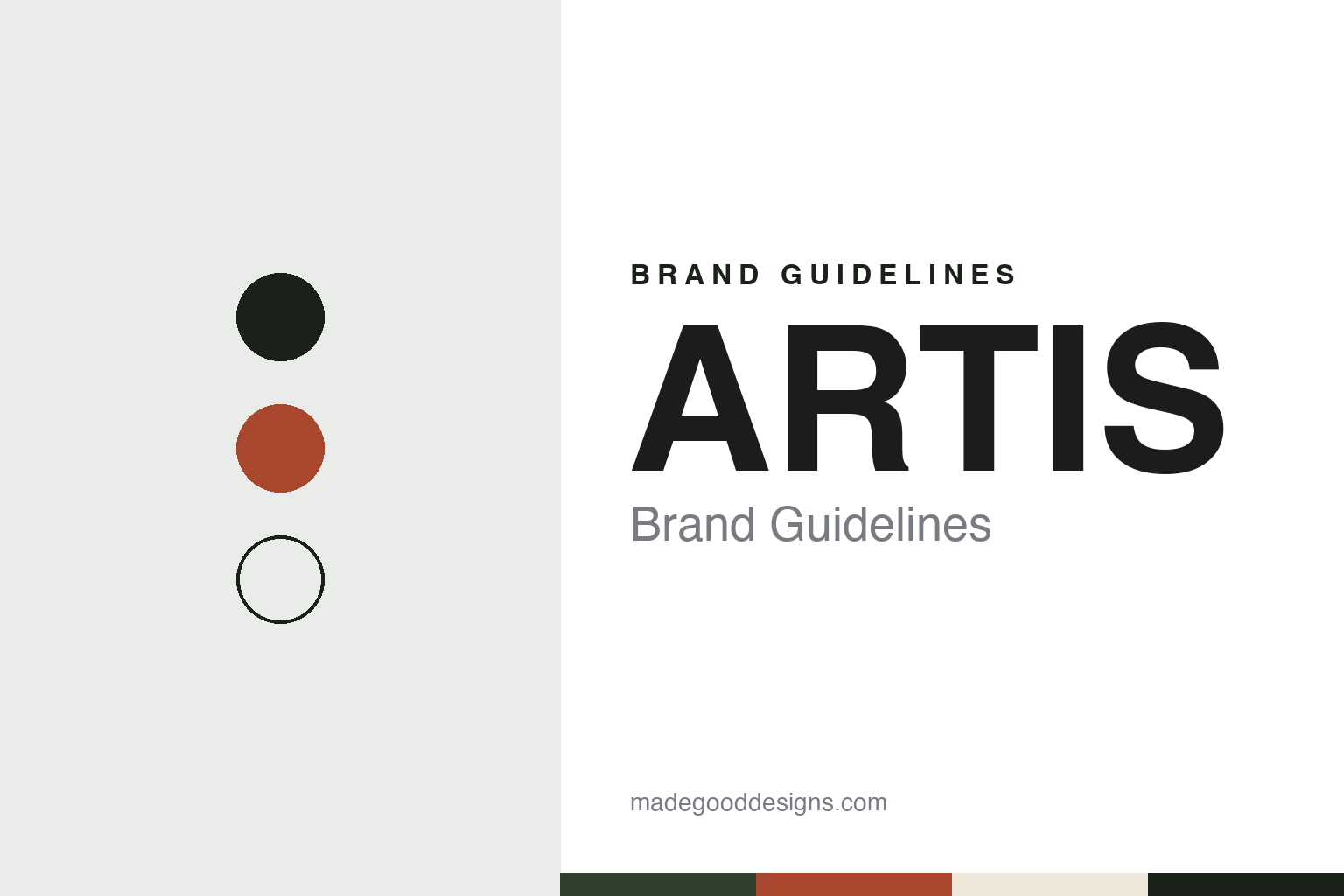
ARTIS Brand Guidelines
Amsterdam’s 1838 zoo society of museums, monuments and gardens.
Aa
Two constants: a Plantage green, brick red and limestone palette and an old-style serif register. Abstract homage — not an ARTIS asset; no logo, sign or building drawing is reproduced.
Natura Artis Magistra
A society for natural history in the Plantage.
ARTIS began on 1 May 1838 as the Zoölogisch Genootschap Natura Artis Magistra (Zoological Society Natura Artis Magistra), founded in Amsterdam by the bookseller and publisher G.F. Westerman and two partners, Dutch Wikipedia and the zoo say. ARTIS translates the Latin name as “Nature is the teacher of art and science”; it was soon shortened in everyday use to Artis. The society bought land in the Plantage, then a green district on the edge of the city, and on 1 May 1852 it received the predicate Koninklijk (Royal), Dutch Wikipedia says. The entrance is on the Plantage Kerklaan.
The early ARTIS was a members’ society. ARTIS says its annual fee matched a month’s wage for an ordinary Amsterdam clerk or labourer, so the garden was largely the domain of wealthy residents; from 1852 non-members could visit in September. The society aimed “to promote the knowledge of Natural History,” ARTIS says, and collected preserved specimens, books and ethnographic objects as well as live animals. In 1839 it bought a travelling menagerie, which led to its first expansion. By 1877 the garden covered ten hectares between the Plantage Kerklaan, the Plantage Middenlaan and the Plantage Doklaan, with a carnivore building of 1859 and an Aquarium that Dutch Wikipedia and DutchNews.nl date to 1882 and ARTIS dates to 1881.
The collections later moved out: the ethnographic objects went to the Colonial Institute, today’s Wereldmuseum Amsterdam, in 1921, and the zoological library passed to the University of Amsterdam in 1939, Dutch Wikipedia says. Under the second director, Coenraad Kerbert, ARTIS turned towards animals and opened up to all residents of the city, the zoo says. In the 1930s it fell into financial trouble; around 1939 its land and buildings were transferred to the City of Amsterdam, ARTIS adds the province of North Holland, while the animals stayed with the society.
During the German occupation of 1940–1945 the zoo continued to operate, and from 1941 Jewish visitors and members were barred on the occupying authority’s orders, NOS reported in a liberation-year series of 2019–2020, as Dutch Wikipedia also records.
Colour
Monuments, museums and a garden of trees.
ARTIS is as much a historic park as a zoo. The zoo says it has 26 national monuments, and Dutch Wikipedia notes more than 800 trees of over 200 species, 74 of them on the city’s list of monumental trees. Its oldest surviving building commissioned by the society is the Main Building on the Plantage Middenlaan, built between 1850 and 1855 to a design by Jan van Maurik in a simple classical style with cast iron and plenty of glass. ARTIS calls it the first building in Amsterdam built specifically as a museum. Downstairs were meeting halls; upstairs, the museum rooms that came to be known as the Groote Museum.
The Main Building closed in 1947, and after a long restoration it reopened in May 2022 as the ARTIS-Groote Museum. The broadcaster EO’s Blauwbloed reported on 10 May 2022 that the museum is laid out in twelve zones, each starting from a part of the human body, and links people with animals, plants and microbes through installations, art, film, sound and scent. Dutch Wikipedia gives 10 May as the opening day; ARTIS gives 6 May.
Other buildings tell the zoo’s story in layers. The 1927 Kerbert terrace, named after Coenraad Kerbert, replaced bars with a moat and a low wall; the Forest House of 1908 has been converted into an indoor jungle, ARTIS says; and the Bird House and Monkey House were restored between 2010 and 2011, Dutch Wikipedia says. The Aquarium closed in 2021 and reopened in June 2026 after a five-year restoration, DutchNews.nl reported on 13 June 2026, with around 250 species and galleries that include the life of an Amsterdam canal.
ARTIS also widened its subject beyond animals. The Planetarium opened in 1988 for the 150th anniversary, and a Geological Museum followed in 1992. In the late 1990s ARTIS added four hectares of former railway land along the Entrepotdok, where an African savanna area opened in 1999. On the new Artisplein in 2014 it opened ARTIS-Micropia, a museum of microbes, on 30 September 2014, according to Dutch Wikipedia; ARTIS calls it the first museum in the world devoted to microorganisms.
Typography
How zoos present themselves.
A zoo usually presents itself through the body that stands behind its name. Some are run by a zoological society founded for the purpose, some by a charity, a company or a city, and some by a state agency that took over from an older society; the Encyclopedia of Melbourne, for example, describes how Melbourne’s acclimatisation society handed its zoo to a state board in 1937. The founding date matters as much as the owner, and many zoos give it a prominent place, whether it falls in the 18th or 19th century or in the decades of the modern site.
The grounds tell the same story in buildings. Older zoos keep historic gates, animal houses and pavilions, some of them on a heritage register, next to large landscaped habitat areas built much later. English Wikipedia describes how Chester Zoo’s founder followed Carl Hagenbeck’s use of moats and ditches in place of bars, an approach that shaped many 20th-century layouts, while the Encyclopedia of Melbourne notes that many 19th-century zoological gardens followed the example of London Zoo.
A large site also needs to be read on the move. Maps, signposts and named areas or zones guide visitors between houses and habitats, and several zoos group their animals by region or climate, so that a path leads from one landscape to the next. Education is part of the offer too, with programmes for schools and families described in general terms on the zoos’ own websites.
Visual identities draw on these layers. Logos often use an animal silhouette or a simple wordmark, signage follows the paths and zones of the site, and the buildings themselves, old and new, carry much of the character. This guide describes each zoo through what dated sources say about its founders, operators, buildings and grounds, and uses colours and type of its own choosing.
Aa
An old-style serif for a nineteenth-century society of gardens and museums. (Specimen set in Libre Caslon Text, a serif STAND-IN; NOT the ARTIS logo.)
ARTIS
One name over a zoo, museums and a planetarium.
The organisation still carries its founding name. Its full title is the Koninklijk Zoölogisch Genootschap Natura Artis Magistra, Dutch Wikipedia says, but the public name is a single word set in capitals: ARTIS. The zoo uses it as a family name for its parts, ARTIS Zoo, ARTIS-Micropia and ARTIS-Groote Museum, alongside the Planetarium and the Aquarium, so that one short name covers a zoo, two museums, an aquarium and a planetarium on one site in the city centre.
Dutch Wikipedia says ARTIS held 545 animal species in 2018, about half the number of fifteen years earlier, as larger enclosures replaced smaller ones. Education is built into the site: there are classrooms near the children’s farm, a lecture hall in the building De Volharding where monthly talks are held, and the planetarium beside the entrance, according to the same source.
For designers, ARTIS is a lesson in heritage as identity. Its strongest visual assets are its nineteenth-century buildings, its ponds made from a former canal, its old trees and its Latin motto, which places nature as the teacher of art. The Main Building, with its classical lines, cast iron and glass, suggests the restrained palette used here, with garden green taken from the park. The newer museums show the other side of the identity: interactive, science-led rooms inside old shells. A guide built on ARTIS would pair a bookish serif, fitting a society founded by a bookseller, with plain modern wayfinding, and let the buildings and the garden carry the colour.
The single word in capitals also solves a practical problem. With several venues on one site and a long Latin name, ARTIS uses its short name as the brand and the venue names as descriptors after a hyphen, a simple naming structure for a site with many doors.
For a design guide, ARTIS shows how a historic society can hold a zoo and its museums under one short name. Compare the Rijksmuseum, another Amsterdam institution housed in a nineteenth-century landmark, and Zoo Zürich, a society-founded zoo of landscapes and halls. For this guide we use a Plantage green, a brick red and a limestone with a serif, an unofficial interpretation; no product or logo is reproduced.
Explore & save
Keep ARTIS’s identity on hand — save it to a board in the Made Good inspiration library.
ARTIS identity set
Pin the ARTIS Plantage green, brick red and limestone palette and the old-style serif register to your own board.
Source & notes
Frequently Asked Questions
What font can I use to match the ARTIS look?
This guide describes ARTIS’s type as “An old-style serif for a nineteenth-century society of gardens and museums”. Its type specimen is set in Libre Caslon Text from Google Fonts as a stand-in; Libre Caslon Text is not ARTIS’s own lettering.
What colours are in the ARTIS palette?
This guide’s ARTIS palette is Plantage green #2E3F2C, Canal night #1A2119, Brick red #A9472F, Limestone #EFE8DA and Paper #F8F6F1. The tones are the guide’s own unofficial interpretation, not official ARTIS hex codes.
When was ARTIS founded?
ARTIS was founded on 1 May 1838, in Plantage, Amsterdam, Netherlands.
Who founded ARTIS?
ARTIS was founded by G.F. Westerman and two partners on 1 May 1838.