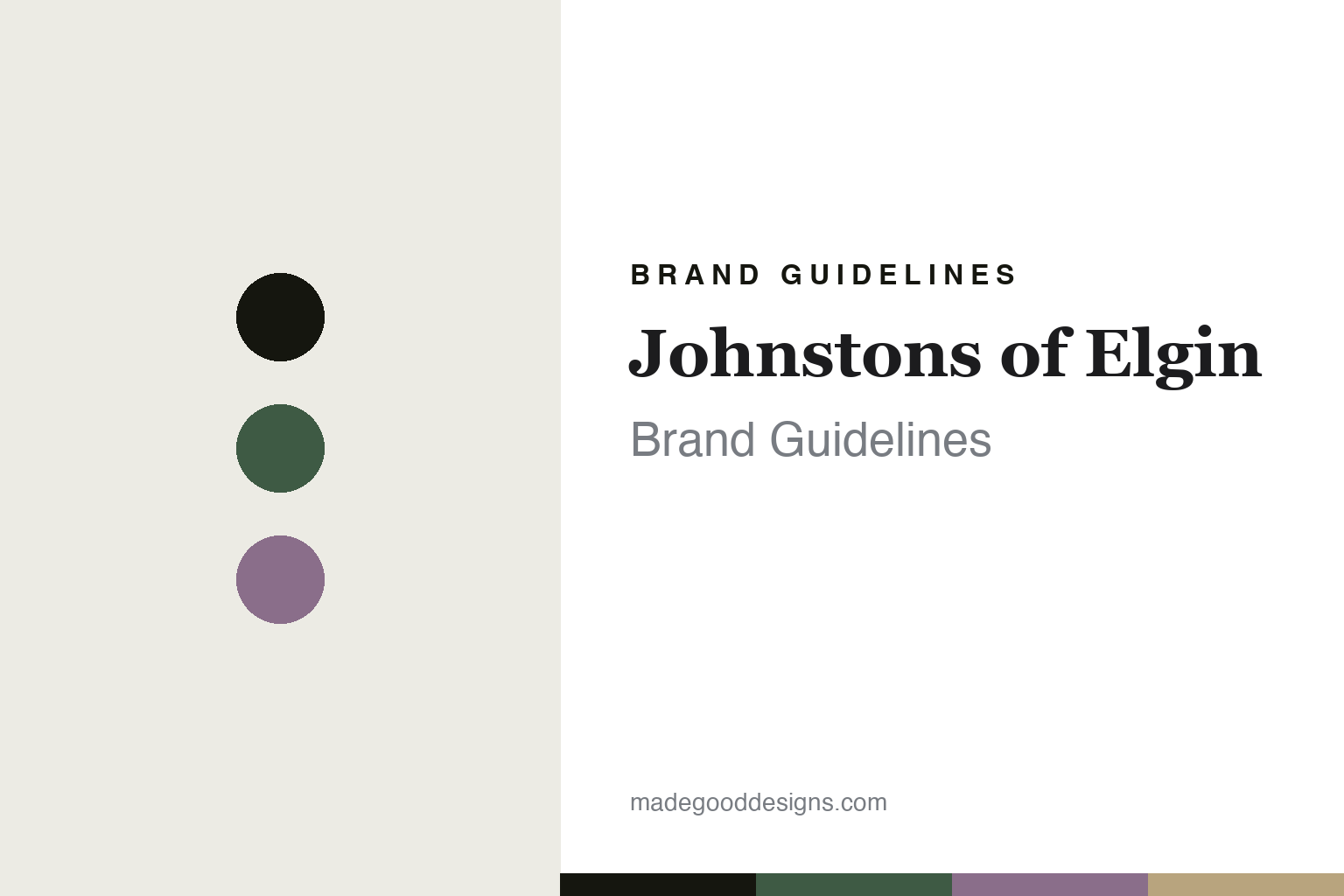
Johnstons of Elgin Brand Guidelines
The cashmere mill.
Aa
Two constants: a green-and-heather palette and a Highland serif register. Abstract homage — not the Johnstons textiles, tweed or packaging.
The cashmere mill
Johnstons of Elgin weaves Scotland into cashmere.
Johnstons of Elgin is a lesson in a vertical mill as identity. Founded in 1797 in Elgin, Moray, Scotland, by Alexander Johnston, it has woven fine wool on the banks of the River Lossie for more than two centuries.
Its identity is cashmere and tweed. Johnstons makes luxury cashmere and fine-wool throws, scarves, knitwear and accessories, with a deep estate-tweed heritage — it wove the first “Super Balmoral” for Queen Victoria in 1853 — across two mills: Elgin for weaving and Hawick for knitwear. It calls itself the only vertical weaving mill still operating in Scotland, holds three royal warrants, and quietly makes cashmere for the world’s luxury houses. A whole craft, under one roof.
(Honest notes: the 1797 founding by Alexander Johnston is verified — but the founding family didn’t stay; the Harrison family has owned it since 1920, so we don’t say “family-owned since 1797.” We attribute the “only vertical weaving mill in Scotland” claim to the company and hedge looser “last woollen mill” paraphrases. It holds three royal warrants (we don’t name a current grantor), is a B Corp (2023), and makes private-label cashmere for houses like Hermès and Chanel. There’s no official brand hex, and we reproduce no actual tweed or tartan — these tones are an unofficial interpretation. This is design commentary and does not promote any product.)
Colour
Johnstons lives in a green-and-heather palette. Click a swatch to copy the hex.
Johnstons’ identity is Highland, natural and refined — a Highland green, an ink, a heather, a camel, and a chalk. The palette pairs a green with a heather — the register of Scottish cashmere and estate tweed. It signals landscape and craft rather than novelty. The honest caveat: with no published brand hex, these tones are an original, unofficial interpretation, not first-party values.
The lesson is a green with a heather signals a Scottish wool mill. Johnstons’ world is a woven, Highland cloth. For designers, it is a reminder that owning the whole process — spinning to finishing, under one roof — can be the identity. Because a mid green can fail as small text, keep type dark and let the colour live in the accents, palette and band. The takeaways: own the whole craft; root in a place; earn the warrants; and treat any single hex as unofficial.
Typography
The register is a Highland serif — refined, natural, Scottish.
Johnstons’ identity carries a refined, natural, Scottish spirit — a Highland woven cloth. A classic old-style serif captures the mood: it is dignified and grounded, the register of a two-century mill. Set in a green-and-heather palette, the Highland serif feels refined and natural — exactly the personality Johnstons carries. It is heritage rather than trendy, mirroring estate tweed. (Johnstons’ real textiles, tweeds and wordmark are works we describe but do not reproduce, and the exact typeface is not ours to use.) Because it is not ours to use, the honest description is “a Highland serif spirit,” shown here in a stand-in. The type behaves like the brand: refined, natural and Scottish.
Aa
A Highland serif spirit — refined and natural. (Specimen set in Cormorant Garamond, a classic old-style serif STAND-IN; NOT the Johnstons packaging.)
A vertical mill as identity
Johnstons of Elgin stands for cashmere and tweed.
Johnstons of Elgin is a lesson in making the whole craft the identity. A green-and-heather palette, a Highland serif and a woven cloth make cashmere and tweed the whole brand — refined, natural, Scottish. The mill is the differentiator. The differentiator is owning every step, in Scotland, for two centuries.
For designers and brand-builders, Johnstons offers a clear takeaway: own the whole process. The lessons: own the craft; root in a place; earn the warrants; and be honest about the story. It is also a reminder to stay accurate: it was founded in 1797 by Alexander Johnston, has been Harrison-owned since 1920, and weaves in Elgin and Hawick — the palette here is an unofficial interpretation. Johnstons made the mill the brand — proof that owning the craft can be the difference.
Explore & save
Keep Johnstons of Elgin’s identity on hand — save it to a board in the Made Good inspiration library.
Johnstons of Elgin identity set
Pin the green-and-heather palette and the Highland-serif register to your own board.