Julius Meinl Brand Guidelines
The Vienna coffee roaster behind the red fez.
Aa
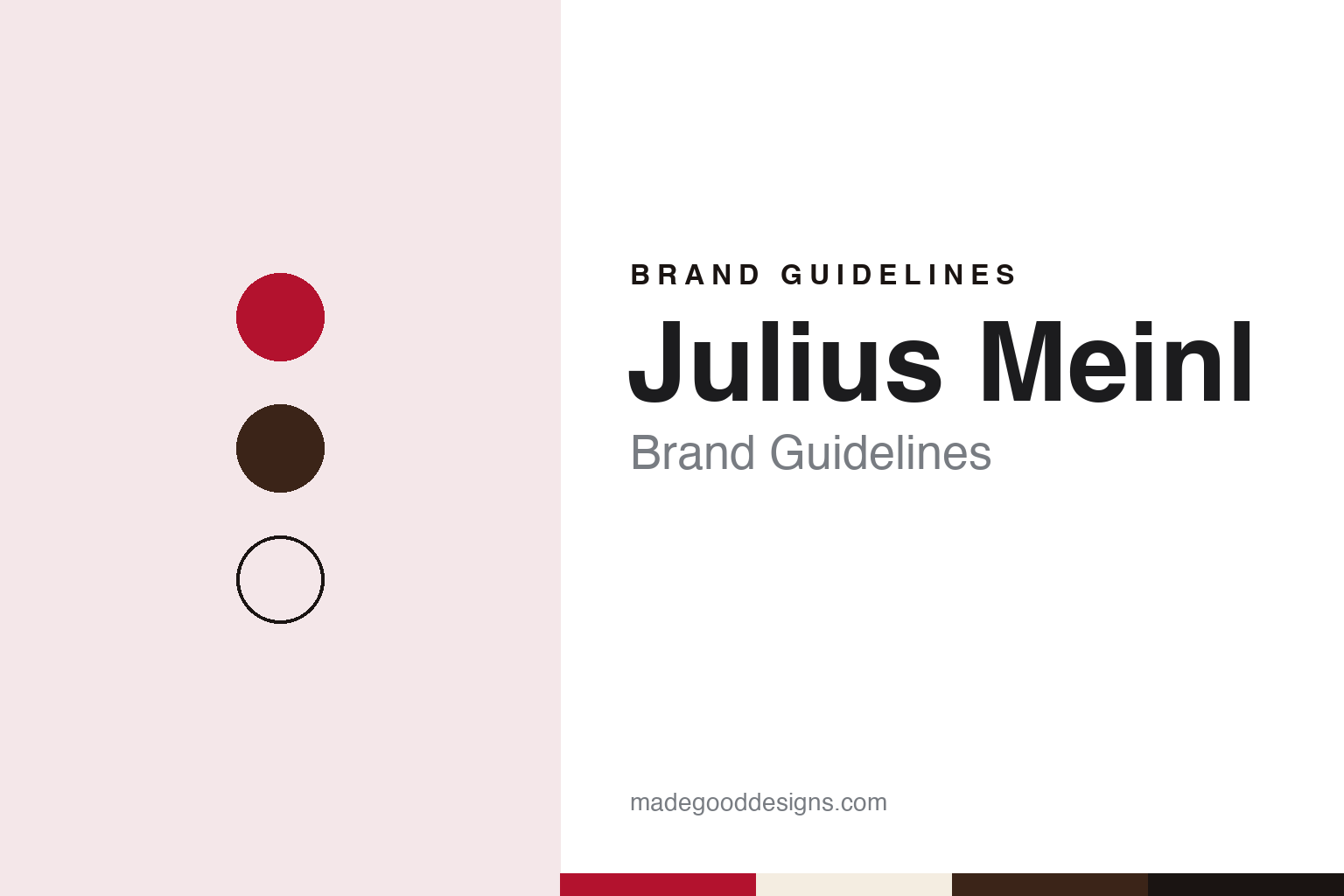
Two constants: a Julius Meinl red, brown and cream palette and a Classic serif register. Abstract homage — not a Julius Meinl product or mark; no logo, figure or packaging is reproduced.
A spice shop in Vienna
Green beans, then a roasting process of its own.
Julius Meinl began in Vienna in 1862, when Julius Meinl I opened a spice shop in the city centre. The company says the shop sold green coffee beans, cocoa, tea, spices, rice and sugar; German Wikipedia places it on the Fleischmarkt, in the first district, and says it sold green beans at first and freshly roasted coffee later. In 1877, the company says, Julius Meinl I developed his own roasting process, in which the beans no longer came into contact with coal gases.
The business grew into a food group. In 1912 it moved its headquarters to a street in Vienna’s 16th district, Ottakring, that is now called Julius-Meinl-Gasse — named after Julius Meinl II in 1954, the company says — and it is still there. German Wikipedia says the company opened its own import office in London the same year, and that under Julius Meinl II, who took sole charge in 1913, it became the largest food retailer of the Habsburg monarchy; the company describes itself in 1913 as the largest coffee roaster of the Austro-Hungarian Empire. It became a joint-stock company in 1919 and in 1927 received the Austrian state award that allowed it to use the federal coat of arms, German Wikipedia says.
By 1939, according to German Wikipedia, the group ran more than a thousand shops. In 1950 it opened a Vienna flagship at Graben 19, which still trades as the delicatessen Meinl am Graben.
Colour
From grocer back to coffee.
The grocery business ended at the turn of the century. After heavy losses, Julius Meinl V, of the fifth generation, withdrew from food retailing, German Wikipedia says: in spring 1999 the shops in central and western Austria went to Billa, part of the Rewe group, and in May those in Vienna, Lower Austria and Burgenland went to Spar. English Wikipedia summarises the sale, in 1998–1999, as being to REWE. The Hungarian shops went to Delhaize in 1999, and the Czech and Polish ones to Ahold and Tesco in 2005, German Wikipedia says. Only the Graben store was kept, as a flagship. The company was delisted from the Vienna Stock Exchange in February 2007, according to English Wikipedia.
What remained was coffee and tea. Today the company calls itself the Julius Meinl Coffee Group, “an Austrian family business” with subsidiaries and sales partners in more than 70 countries and over 1,000 employees. Its main markets, it says, are Austria, Italy and Central and Eastern Europe, and it names its clients as catering, tourism and retail businesses. Its sustainability reports, the first of them in 2019, are published by Julius Meinl Industrieholding GmbH. German Wikipedia gives revenue of €260 million and 1,077 employees for 2024.
On where the coffee is roasted, the company says it has a roasting plant at its Julius-Meinl-Gasse headquarters in Vienna “specialising in Viennese roasting,” and that in 2005 it established a second plant in Vicenza, in northern Italy, “focusing on darker Italian roasts.” German Wikipedia states, without giving a source, that the whole Meinl coffee range, including the Jubiläum and Präsident blends, is now produced at a Meinl roastery in Italy. We give both accounts.
Its best-known products are blends. The company dates the Jubiläum (“Jubilee”) blend to the 100th anniversary in 1962 and Präsident to 1980, followed by 1862 Premium for restaurants in 2009, Inspresso capsules in 2016 and The Originals in 2017. Its “Pay with a Poem” campaign, in which customers can pay for a drink with a poem, began in Bucharest in 2014, English Wikipedia says. Christina Meinl was appointed president of the Specialty Coffee Association in February 2020, according to the same source.
Typography
Design and documentation.
The seven brands in this group all roast coffee, and they come from five European countries: Segafredo Zanetti and Kimbo from Italy, Julius Meinl from Austria, Tchibo and Dallmayr from Germany, Douwe Egberts from the Netherlands, and Paulig from Finland. Coffee brands in general sit at many different points in the trade, from vacuum packs on a supermarket shelf to espresso poured in a café under the roaster’s own sign, and a single company can work at both ends at once.
A coffee brand’s identity is usually carried less by a place of growth than by a blend, a pack and the cup it promises, because the beans inside will have been grown a long way from where the name on the front was roasted. That makes the questions behind each name worth asking plainly: who started it, who owns it now, where its coffee is bought, and where it is actually roasted and packed.
Each guide separates what independent sources record from what the company says about itself — its founding story, its owners over time, where its coffee comes from and where it is roasted — and marks plainly what rests only on the company’s own word.
Aa
A classic serif — for a Vienna coffee-house name. (Specimen set in Playfair Display, a serif STAND-IN; NOT the Julius Meinl logo.)
The Meinl logo
A figure in a red fez, redrawn by Matteo Thun.
The company’s first mark, German Wikipedia says, was a sailing merchant ship in a horizontal oval. In 1924 it was replaced by a figure drawn by the Viennese graphic designer Joseph Binder: a boy wearing a red fez. The company says Binder was asked to create a fictional character for the story of how coffee came to Vienna — the legend of Georg Franz Kolschitzky, said to have opened a coffee house with sacks of coffee left behind after the Ottoman siege of 1683 — and that he drew “a young Ottoman coffee expert raising a cup to his mouth.” In German the figure is known as the Meinl-Mohr. German Wikipedia describes the version used until 2004 as a black child’s head with a tall red fez on a yellow ground, and says metal signs bearing it were part of Austrian street scenes until the 1990s.
In 2004 the Italian designer Matteo Thun redrew the logo. The company says he recreated it “in its current monochrome red, greatly simplified form,” that the historic templates reminded him of Viennese Baroque angels, and that he carried the design into three dimensions: an upturned red fez gives the shape of the brand’s cups, jugs and glasses. English Wikipedia says the redesign set the figure upright and used a single colour for the whole logo, removing the boy’s dark skin colour. The company dates its “Trend” cup to 2004 and new packaging designed by Thun to 2010.
The figure has also been debated. In December 2007 Die Presse asked whether the Meinl-Mohr was a “symbol of racism,” in a report on an initiative called Mein Julius, which used an older version of the logo in protest against racist stereotypes, according to Wikipedia. In October 2021 Der Standard reported that the Meinl am Graben delicatessen had dropped the figure, keeping only the fez, on a petrol-coloured ground; German Wikipedia says that change applies to the delicatessen only. The coffee company’s website still describes its logo as a young man wearing a fez.
For a design guide, Julius Meinl shows how a 1920s emblem can be simplified into a single-colour mark and carried into the shape of the cup itself. Compare illy, another European coffee brand with an artist-designed logo, and Tchibo. For this guide we use a fez red, a roast brown and a coffee-house cream with a serif, an unofficial interpretation; no product or logo is reproduced.
Explore & save
Keep Julius Meinl’s identity on hand — save it to a board in the Made Good inspiration library.
Julius Meinl identity set
Pin the Julius Meinl red, brown and cream palette and the Classic serif register to your own board.