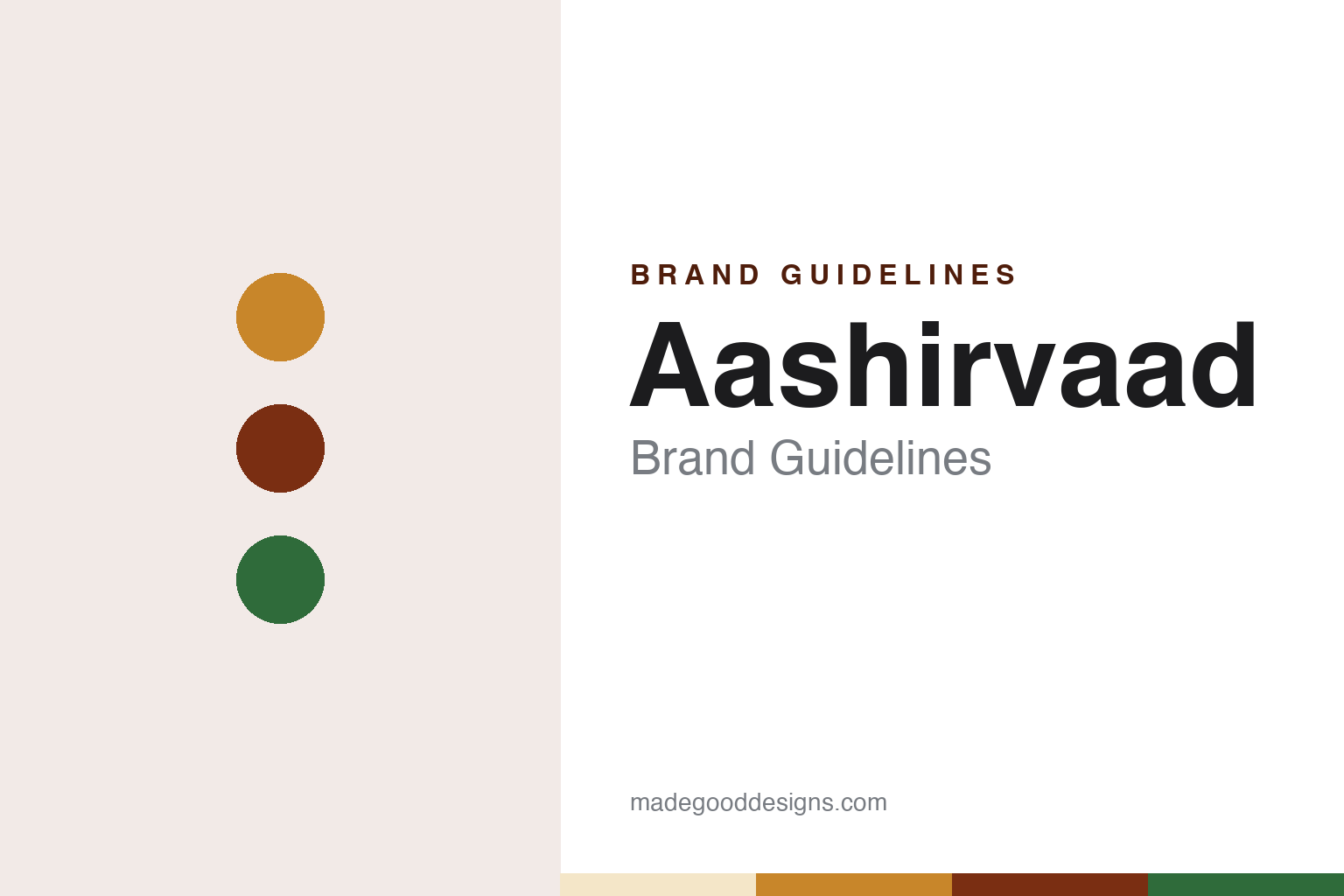
Aashirvaad Brand Guidelines
ITC’s 2002 atta in a Madhubani farming pack.
Aa
Two constants: a wheat gold, chakki brown and field green palette and a folk-art serif register. Abstract homage — not an Aashirvaad product or mark; no pack, logo or artwork is reproduced.
An atta from a tobacco-to-hotels group
ITC enters packaged flour, May 2002.
Aashirvaad is the staples brand of ITC Limited, and it began with a single product. English Wikipedia, citing ITC, says ITC entered the branded atta market — packaged whole-wheat flour — with the launch of Aashirvaad Atta in Bengal and Chandigarh in May 2002; it gives the date as 26 May, while a timeline on the brand’s own website in 2018 gave 27 May 2002. From those two markets the atta spread across India.
In an interview with The Economic Times in February 2010, V. L. Rajesh, then general manager for marketing at ITC’s foods division, described ITC as one of the youngest organised players in the industry, having entered foods in 2002, and said branded atta was still less than 3% of the total atta market. He said Aashirvaad held an urban volume share of more than 50% among the national branded atta players. The Hindu BusinessLine reported in March 2018 that Aashirvaad led the packaged-atta market with a 28% share.
The brand’s pitch rested on where the grain came from. The Aashirvaad website said as early as 2007 that the brand sources its products directly from farmers through e-Choupal, the network of village internet kiosks set up by ITC’s agri-business division. A later version of the site explained that choupal means a gathering place in Hindi and that the kiosks are run by farmers, called sanchalaks, who use them to check weather and market prices in their own language. Aashirvaad says it hand-picks grain and spices from these sources.
Colour
A farming scene on a flour bag.
The Aashirvaad pack has a documented design idea behind it. The brand’s website said in 2012 that the Aashirvaad atta pack is made of PET poly and that its design shows the farming process in the rural heartland of India in the form of a Madhubani painting. English Wikipedia repeats the description, citing the same site. In 2018 the brand said it used PET poly packaging to keep its chakki atta fresh and a four-layer pouch for its instant mixes.
Packaging has also been a source of recognition, by the brand’s own account. The Aashirvaad website said in 2007 and again in 2012 that the 5 kg pack of Aashirvaad Select atta had won a World Star Award for excellence in packaging in the consumer-pack category; it did not give the year. Select is the brand’s premium atta. The brand’s 2018 timeline dated its launch to March 2005 and said it is made entirely from Sharbati wheat from seven districts of Madhya Pradesh, including Sehore; English Wikipedia also names Sehore district as the source.
Around the atta the brand built a wider kitchen range. English Wikipedia, citing ITC, dates Aashirvaad Spices to May 2005 in northern India, with organic chilli, turmeric and coriander powders following in July 2007, and instant mixes such as gulab jamun, rava idli and dosa to March 2006. It dates Aashirvaad salt to March 2003, while the brand’s 2018 timeline placed the salt launch in March 2007. A multigrain atta followed in May 2010, according to that timeline, and Moneycontrol reported in 2021 that ITC had added ready-to-mix breakfast dishes such as poha, upma and sambar.
Typography
Design and documentation.
The seven brands in this group all make food, and all of them come from India: Bikaji, Lijjat, Mother Dairy, Nandini, Aashirvaad, Kissan and Ching’s Secret. Indian food brands in general sit at many different points in the trade, from family firms and cooperatives to names that now belong to much larger food groups, and a single brand can be sold everywhere from a neighbourhood kirana shop to a supermarket shelf.
A food brand’s identity is usually carried less by a single product than by a pack, a name and the meal or snack it promises, because the company behind the name may have changed hands, moved its factory or grown far beyond the town where it started. That makes the questions behind each name worth asking plainly: who started it, who owns it now, and where its food is actually made and packed.
Each guide separates what independent sources record from what the company says about itself — its founding story, its owners over time, where its food is made and how its packaging has changed — and marks plainly what rests only on the company’s own word.
Aa
A folk-art serif for a flour pack painted like a Mithila village. (Specimen set in Tiro Devanagari Hindi, a serif STAND-IN; NOT the Aashirvaad logo.)
Aashirvaad
From one flour to a kitchen brand.
Aashirvaad has never changed hands; it has been an ITC brand since its launch, and ITC has stretched it well beyond flour. The Economic Times reported in October 2015 that ITC was entering the dairy market with Aashirvaad ghee, and in March 2022 the same paper described a dairy business selling milk, curd, paneer, lassi and mishti doi under the Aashirvaad Svasti name, focused for the time being on eastern India. Mint reported in July 2019 that ITC was building out a wider portfolio under the brand. By 2026 the brand’s website listed atta in many variants alongside salt, besan, millet flours, vermicelli, ready-to-cook naans and parathas, ghee, instant mixes and meals, whole and blended spices, soya chunks and chutneys.
In 2018 ITC put up a page rebutting videos circulating online that claimed Aashirvaad atta contained plastic. ITC said the stretchy residue shown in the clips was wheat gluten, which is found naturally in all atta, said its atta is made in HACCP- and ISO-certified manufacturing locations, and said a court in Bengaluru had barred people from circulating material making the claim, with criminal complaints also filed in Kolkata and Hyderabad.
Beyond the shelf, the brand has tied itself to culture and public-health messages. Its website said in 2007 that Aashirvaad supported the revival of traditional art forms such as Bharatanatyam and rangoli, and that spreading the message about the importance of iodine in rural villages was a cause close to its heart. In 2026 its website listed iodine-deficiency school and community contact programmes among its initiatives.
For a design guide, Aashirvaad shows how a packaged staple can borrow a folk-art tradition to tell a farm-to-kitchen story on every bag. Compare MTR, the Bengaluru maker of instant mixes and ready meals, and Everest, the Mumbai masala brand. For this guide we use wheat gold, chakki brown and field green with a serif, an unofficial interpretation; no product or logo is reproduced.
Explore & save
Keep Aashirvaad’s identity on hand — save it to a board in the Made Good inspiration library.
Aashirvaad identity set
Pin the Aashirvaad wheat gold, chakki brown and field green palette and the folk-art serif register to your own board.