Koff Brand Guidelines
Sinebrychoff’s 1957 beer name, its red and its brewery horses.
Aa
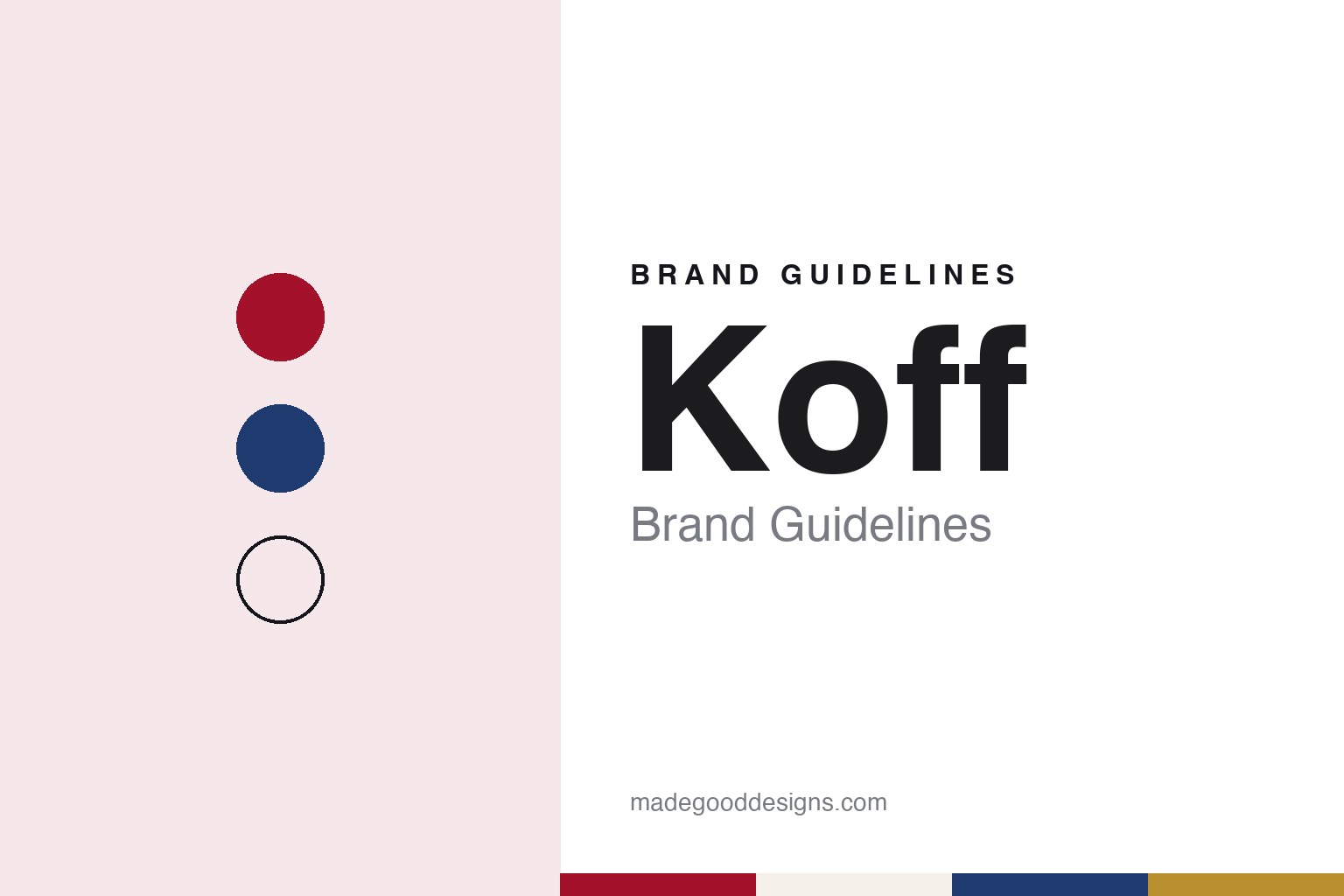
Two constants: a Koff red, blue and gold palette and a bold slab serif register. Abstract homage — not a Koff product or mark; no can, label, logo or horse emblem is reproduced.
A brewery at Hietalahti
A merchant family from Russia and a beer licence won at auction.
Koff is the beer brand of Sinebrychoff, a brewery older than the brand by well over a century. The company traces the family to Peter Sinebryukhov, a poor crown peasant from north of Moscow who moved to Old Finland in the late eighteenth century, settled at Kymi and was allowed to keep a shop and tavern at the Ruotsinsalmi fortress, where he became a brewer and army trader. His eldest son, Nikolai Sinebrychoff, took over the family business at sixteen and followed his customers, the army, to Suomenlinna after the Finnish War, the company says.
In 1819, according to the company, Nikolai won at auction a ten-year exclusive right to brew and sell beer in Helsinki, and on 13 October 1819 the imperial new-building committee granted him land for a brewery at Hietalahti, on the edge of the planned town. Sinebrychoff treats that date as its founding day, and it is also celebrated as Finnish Beer Day. Finnish Wikipedia gives the same date for the permission to buy the plot, south of the Hietalahti market square; English Wikipedia describes Nikolai as a Russian businessman and the company as the oldest still-operating brewery in the Nordic countries, a title the company also claims, along with being Finland’s oldest food company.
Finnish Wikipedia says the brewery first made cider, porter and top-fermented ale, and adopted bottom fermentation in 1853; the company says it brought pure-yeast lager to Finland in the 1880s. The family’s buildings still stand. A wooden office that Nikolai moved from Suomenlinna in 1823 is beside the brewery stable on Bulevardi, and the empire-style stone house completed there in 1842 as the family’s home and office is now the Sinebrychoff Art Museum, built on the collection that Paul Sinebrychoff the younger and his wife Fanny left to the Finnish state, the company says. The garden Nikolai laid out in 1836 became Sinebrychoff Park.
The firm became a limited company, Aktiebolaget P. Sinebrychoff, in 1888, and in 1917 management passed outside the family name, to Axel F. Hornborg, the husband of a niece of Paul the younger, according to the company. Finland’s prohibition, from 1919 to 1932, confined the brewery to mild malt drinks; it began making soft drinks in 1955.
Colour
A name cut from a surname, sold by a film star.
The Koff name arrived in 1957, when the company launched both Koff and Sinebrychoff Porter, according to Sinebrychoff and its Koff website. Finnish Wikipedia says the short form comes from the last part of the family name, and the Koff website credits the name itself to a Helsinki advertising man, Keijo Kiukkola. The brand was carried by the actor Tauno Palo, whose advertisements in print and on television used the line “Sano vaan reilusti KOFF” — roughly “just say Koff, straight out” — which the company says made Koff the country’s favourite beer.
The decisive moment was a change in the law. On 1 January 1969, medium-strength beer could for the first time be sold in grocery shops and cafés rather than only in the state alcohol shops and restaurants. The Koff website tells how Sinebrychoff’s lorries waited in a nearly finished tunnel near the Hietalahti brewery for midnight, since nothing could leave the brewery gate before then, and set off a little early when impatient revellers fired their rockets. Koff 3, launched the year before, became the biggest medium-strength beer brand of 1969, the site says, and the first Koff can followed in 1971.
Much of Koff’s look comes from the brewery’s horses. The company says it has kept a stable and dray horses at Hietalahti for some two hundred years: nine horses by 1848, horses bought in St Petersburg in the 1860s, a new stable for sixty in 1890, and around forty in the late 1930s, when they still delivered most of the drinks in the city and hauled ice cut from the sea to cool the cellars. Almost all were handed to the defence forces during the Winter and Continuation Wars, and lorries took over deliveries at the end of the 1940s. In the 1960s two horses named Koff and Siff returned for publicity work. Today Danish-bred Jutland horses pull Sinebrychoff’s red beer drays on restaurant rounds in central Helsinki from the stable on Bulevardi; the company notes that Carlsberg has worked with Jutland horse breeders since 1928.
English Wikipedia describes Sinebrychoff’s logo as brewery horses beneath a golden crown, shown since 2009 as blue horses on white or the reverse. The brand’s colour is its red: the company calls its drays “Koff red,” and the Koff website says that in 2021 the brand set its red aside for the first time, for blue, white and gold, marking Finland’s first men’s European football championship. The red SpåraKOFF, a pub tram converted in 1995 for the brewery’s 175th anniversary from a 1959 Helsinki tram and run with HOK-Elanto and the city’s transport authority, carries the name around the city centre in summer, the site says. The Koff website itself sets its type in Clarendon and Trade Gothic Next.
Typography
Design and documentation.
The seven brands in this group all make food or drink, and they come from Finland and Norway: Hartwall, Koff, Mills, Solo, Olvi, Lapin Kulta and Atria. Food and drink brands in general sit at many different points in the trade, from family firms that still carry a founder’s surname to names that now belong to much larger groups, and a single brand can be sold everywhere from a corner kiosk to a supermarket aisle.
A food or drink brand’s identity is usually carried less by a single product than by a pack, a name and the meal or drink it promises, because the company behind the name may have changed hands, moved its production or grown far beyond the town where it started. That makes the questions behind each name worth asking plainly: who started it, who owns it now, and where its products are actually made and packed.
Each guide separates what independent sources record from what the company says about itself — its founding story, its owners over time, where its products are made and how its packaging has changed — and marks plainly what rests only on the company’s own word.
Aa
A bold slab serif — for a four-letter beer name with two Fs. (Specimen set in Bitter, a slab-serif STAND-IN; NOT the Koff logo.)
Koff
From Hietalahti to Kerava and Carlsberg.
Sinebrychoff grew by acquisition. In 1972 it bought the brewery at Pori, and with it the Karhu beer, according to the company and Finnish Wikipedia. In 1984 the Rettig group bought Sinebrychoff, and the next year Sinebrychoff bought the Pyynikki brewery in Tampere, the company says. It had once made Pepsi drinks alongside its own soft drinks; in January 1999 it began making, selling and distributing Coca-Cola’s drinks in Finland, a licence that Finnish Wikipedia says moved to it from the rival Hartwall. The company says it launched Finland’s first energy drink, Battery, in 1997.
Ownership then passed to Denmark. By the end of 1999 Sinebrychoff was wholly owned by the Carlsberg group, the company says, and English Wikipedia agrees; the timeline on the same company page dates its entry into Carlsberg to 2000.
The brewery left Hietalahti in the 1990s. Its old buildings had grown too small and were hard to modernise, the company says, and a site was found at Kerava, north of Helsinki, beside the main road to the north. Construction began in 1990 and the plant was inaugurated in 1992, according to the company; Finnish Wikipedia says the opening was celebrated in April 1993 with the finance minister, Iiro Viinanen. The Pori brewery closed in 2009 and Karhu production moved to Kerava, Finnish Wikipedia says, and the company now says all its brewing is concentrated there. The horses, the park and the art museum keep the name at Hietalahti.
Koff has also built its name through sport and the city. The Koff website says its sponsorship of the Helsinki ice-hockey club HIFK has run since 1985, marked in 2015 by a special can of Koff III, and that in 2021 the Helsinki clothing brand Makia made three collections with Koff drawing on the brewery’s colours and illustrations, with a beer brewed to an original recipe from the archive.
For a design guide, Koff shows how a beer name of four letters can borrow its imagery from the company behind it — the horses, the crown, the drays and the tram — and keep it alive through a single colour. Compare Hartwall, its long-time Finnish rival, and Olvi, the brewer from Iisalmi. For this guide we use a Koff red, a horse blue and a crown gold with a slab serif, an unofficial interpretation; no product or logo is reproduced.
Explore & save
Keep Koff’s identity on hand — save it to a board in the Made Good inspiration library.
Koff identity set
Pin the Koff red, blue and gold palette and the bold slab serif register to your own board.