Honest Tea Brand Guidelines
A business-school idea, a home kitchen and a name that did the selling.
Aa
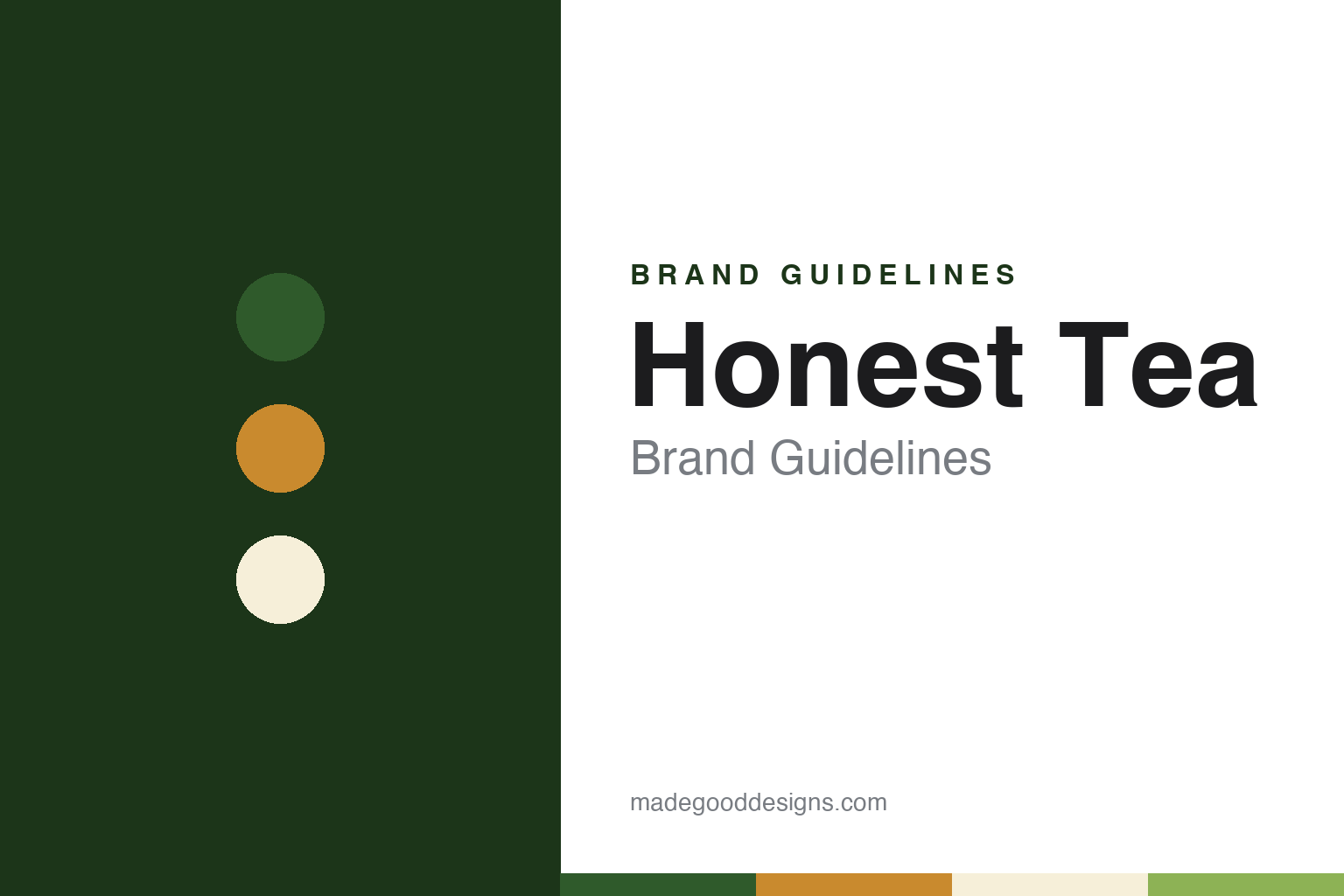
Two constants: a tea-leaf green, steeped amber and label cream palette and a soft display serif register. Abstract homage — not an Honest Tea product or mark; no bottle, label or logo is reproduced.
A classroom and a kitchen
A Yale classroom, a trip to India and a name before there was a drink.
Honest Tea was an American bottled tea brand based in Bethesda, Maryland. It no longer makes tea. The Coca-Cola Company, which owned it outright from 2011, announced in May 2022 that it would phase out the Honest teas at the end of that year, and the name now lives on in the Honest Kids juice drinks. The address that once belonged to the tea company now forwards to Coca-Cola’s own page for Honest Kids.
The brand was founded in 1998 by Seth Goldman and Barry Nalebuff, as English Wikipedia and the trade publication FoodBev both record. Wikipedia describes Goldman as a graduate of Harvard and the Yale School of Management, and Nalebuff as one of his Yale professors; the two conceived the company together and raised its start-up money from friends and family.
The company’s own telling, archived from its website in 2014, starts in a classroom. Honest Tea said that Goldman, an active runner and basketball player, found the drinks on offer either too sweet or too bland, and that he and Nalebuff discovered a shared interest in a different kind of drink during a class discussion of a Coke-versus-Pepsi case study in 1994. In 1997, the company said, Goldman went for a run in New York with a college friend, ended up mixing drinks again afterwards, and emailed Nalebuff to ask whether he was still interested in the idea.
Nalebuff, by the company’s account, had just returned from India, where he had been studying the tea industry for a case study. He came away with the impression that much of the tea bought by American bottlers was the dust and fannings left over from whole-leaf tea, and he had already coined a name for a bottled tea made from real leaves: Honest Tea. The company said the name was what turned a simmering idea into a business, because it suited a brand that wanted honest relationships with customers, suppliers and the environment.
What followed, in the company’s words, was a kitchen operation. Goldman quit his job at the mutual-fund firm Calvert and began brewing batches of tea at home. Five weeks later he took thermoses of tea and a recycled bottle wearing a mock-up label to a buyer at Fresh Fields, the East Coast natural-foods grocer that Wikipedia notes was later acquired by Whole Foods Market. The buyer placed an order, and the founders then had to work out how to make that much tea. The company’s archived timeline dates the launch to February 1998, from Goldman’s home, and says its opening teas reached shelves that June with names including Gold Rush Cinnamon, Kashmiri Chai, Black Forest Berry and Moroccan Mint Green.
Colour
A Coca-Cola stake, full ownership and a 2022 phase-out.
The range widened through the 2000s, according to the company’s archived timeline. It added a line of thirst quenchers called Honest Ade in 2005, children’s drinks under the name Honest Kids in 2007, and a sparkling line called Honest Fizz in 2013. The same timeline says the company moved into new headquarters in 2007 and that its products were sold through the Coca-Cola bottling network from 2009, with the national rollout completed in 2010.
That bottling network came with an investor. FoodBev reported in May 2022 that Coca-Cola took an investment stake in Honest Tea in 2008 before fully acquiring the brand in 2011, and English Wikipedia gives the same two dates. Honest Tea’s own account puts the full purchase in March 2011. The company said in 2014 that it was run as an independent business unit inside Coca-Cola, and that Goldman continued to lead it from Bethesda with the title of President and “TeaEO”. Coca-Cola added another line under the name in 2021, when, Wikipedia says, it introduced Honest Yerba Mate.
The end of the teas was announced on 23 May 2022. Wikipedia says Coca-Cola decided to keep two ready-to-drink tea brands, Gold Peak and Peace Tea, and to stop carrying Honest Tea beverages from 31 December 2022. FoodBev quoted Coca-Cola as saying it was prioritising “fewer, bigger brands”, and quoted Sabrina Tandon, a group director for ready-to-drink tea at Coca-Cola North America, as saying the company was “phasing out the Honest teas product line, but are not selling the Honest brand.” Business Insider reported on 25 May 2022 that Coca-Cola would discontinue production and sales of Honest Tea by the end of the year, and that it would continue to produce Honest Kids.
The founder’s reaction was public. FoodBev reproduced a post by Goldman from the day of the announcement in which he called the decision a “gut punch” to everyone who had worked to build the brand. Wikipedia records that Goldman and Nalebuff returned to bottled tea in September 2022 with a new brand, Just Ice Tea, launched with the chef Spike Mendelsohn.
One market followed a different path. Wikipedia says the Honest Tea trademark in Australia belongs to a separate small company, Springleaf, whose founder Annabel Young won a case against Coca-Cola there in 2015 and kept the name. As of October 2026, honesttea.com forwards to The Coca-Cola Company’s United States page for Honest Kids, the line that carries the Honest name forward.
Typography
Design and documentation.
Ready-to-drink tea, flavored water, sports drinks and craft soda share a cooler shelf, but their packaging asks different things of a label. A tea can or tall glass bottle is often read from several feet away, so the name, the flavor and a colour cue have to work together at a glance, while the back of the pack carries ingredients, nutrition panels and the legal small print that every drink must show.
Flavored-water and sports-drink bottles tend to lean on colour coding, since a shopper picking one flavor from a long row is often matching a hue rather than reading a word. Craft-soda labels sit at the other end: many use illustration, hand lettering or a story on the bottle to suggest a small maker, even when the brand has since become part of a much larger drinks company.
Each guide in this group looks at who started the brand, who owns it now and how its labels, logos and bottles have been described in dated sources, and it marks plainly where a statement rests only on what the company says about itself. The colours and type shown are our own unofficial interpretation.
Aa
A soft, slightly old-style display serif — a warm, plain-spoken register for a brand built on its name. (Specimen set in Fraunces, a display serif STAND-IN; NOT the Honest Tea logo.)
A name on the label
A mock-up label, a lighter bottle, a relabel and a slogan that repeated the name.
The brand’s main asset was its name, and the company’s own history keeps returning to the label. The founders’ sales pitch to Fresh Fields, as Honest Tea told it, rested on a recycled bottle wearing a mock-up label. The flavour names on the early range were part of the voice: the company’s timeline lists teas such as Peach Oo-la-long, Haarlem Honeybush, Lori’s Lemon and Heavenly Lemon Tulsi alongside its chai and mint teas.
The packaging changed several times after Coca-Cola arrived. The company’s timeline says it relabelled its plastic-bottle line in 2008. In 2009 it introduced a new, lighter plastic bottle with an unusual shape, including a deep depression in the base to keep it pressurised, which the company said left some customers puzzled; it updated the labels with a note explaining the greener bottle. In 2010 it dressed a run of tea in pink labels as part of a partnership with Susan G. Komen for the Cure. In 2011, the year of the full Coca-Cola purchase, the company says it refreshed its plastic-bottle labels to put more emphasis on the HONEST name and on its ingredients.
Advertising leaned on the same word. Honest Tea says that in the summer of 2012 it ran an integrated advertising campaign with television spots, web videos, billboards and wrapped mass-transit vehicles under the tagline “Refreshingly Honest”. Earlier, its timeline says, the company had toured with a branded sampling vehicle from 2002, run a summer sampling tour with a Ford Escape Hybrid in 2004 and promoted a fleet of branded Saturn hybrid vehicles in 2008. It also ran street experiments it called Honest City and the National Honesty Index, in which unattended drink stands invited passers-by to pay on trust.
The founders also put the story into pictures. The company says Crown Books, a division of Random House, published Mission in a Bottle by Goldman and Nalebuff in 2013, a business book told in comic-book form and illustrated by Sungyoon Choi. In the same period the brand’s line names spread into a family of sub-brands, each built on the one word: Honest Ade, Honest Kids, Honest Splash and Honest Fizz. When Coca-Cola ended the teas in 2022, it told FoodBev that it was not selling the Honest brand, and Honest Kids kept the word on the shelf.
For a design guide, Honest Tea shows how a single plain word can carry a whole beverage identity, from a mock-up label in a grocery buyer’s office to a family of sub-brands, and how that word can outlive the product it was originally written for. Compare it with Gold Peak, the tea brand Coca-Cola chose to keep, and with vitaminwater, another drink Coca-Cola brought in from outside. For this guide we use tea-leaf green, steeped amber and label cream with a soft display serif, an unofficial interpretation; no product or logo is reproduced.
Explore & save
Keep Honest Tea’s identity on hand — save it to a board in the Made Good inspiration library.
Honest Tea identity set
Pin the Honest Tea tea-leaf green, steeped amber and label cream palette and the soft display serif register to your own board.