interpack Brand Guidelines
Düsseldorf’s three-yearly packaging fair since 1958.
Aa
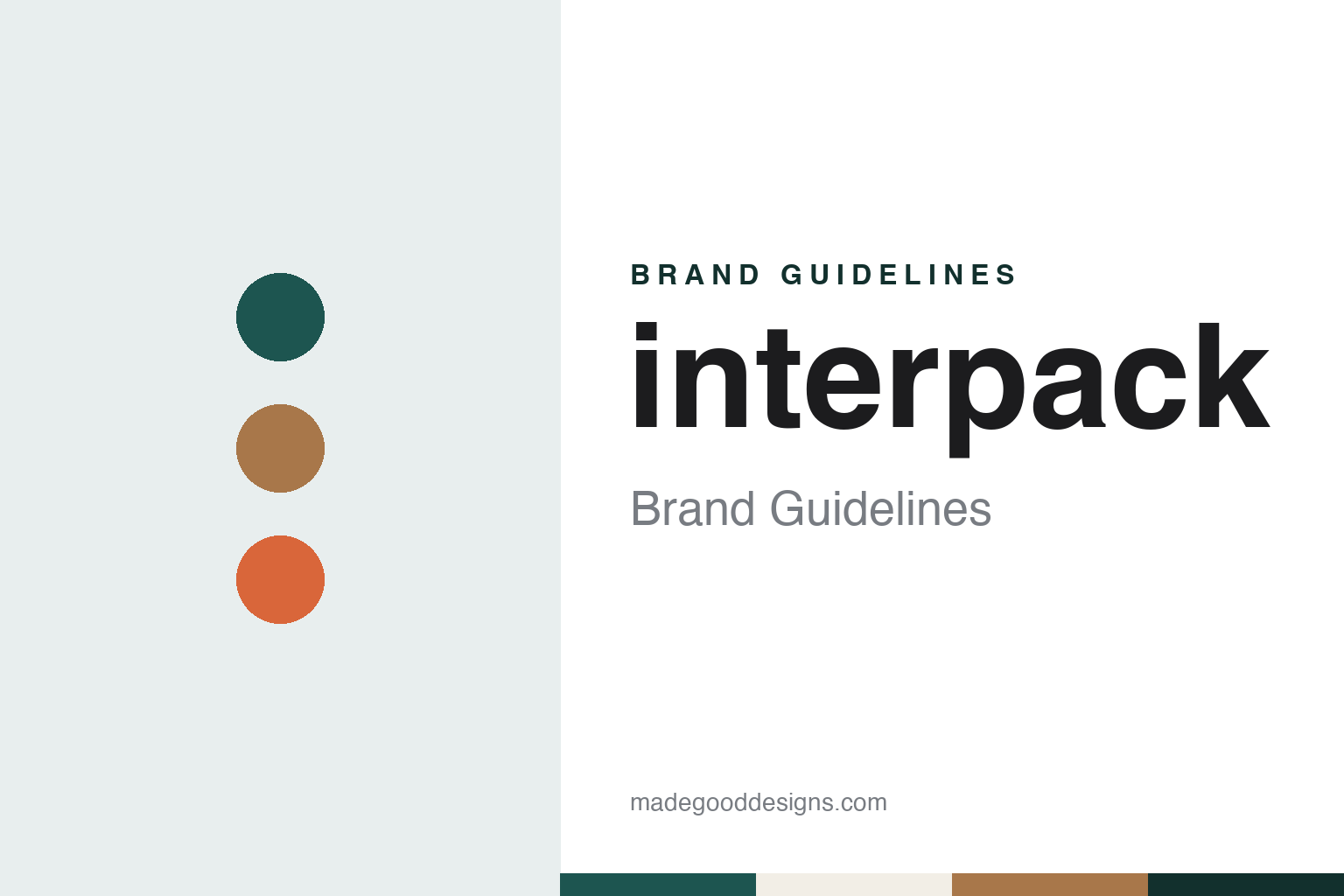
Two constants: a line teal, kraft brown and carton white palette and a lower-case grotesque sans register. Abstract homage — not an interpack asset or mark; no logo, key visual or product is reproduced.
From the Ehrenhof to Stockum
A packaging fair that outgrew its first grounds.
interpack is a trade fair for packaging and the related processing industry, held by Messe Düsseldorf on its grounds in Düsseldorf, Germany. The organiser writes the name in lower case. The first interpack opened on 2 March 1958. The trade magazine neue verpackung, in a history published on 2 May 2018, counts 255 companies and 32,544 visitors at that premiere. German Wikipedia, citing the Rheinische Post of 2008, adds that those exhibitors came from nine countries and that the fair stood on the exhibition grounds at the Ehrenhof.
The second edition followed in 1960, with 515 exhibitors and 55,670 visitors, neue verpackung says, and that year makers of packaging materials joined the machinery builders for the first time. After 1960 the fair moved to a three-year cycle, German Wikipedia says. In 1969 demand for space was so high, the magazine writes, that the organiser stretched the grounds to 100,000 square metres with a temporary extension and some exhibitors built their stands in tents. That pressure, together with the growth of other Messe Düsseldorf fairs such as K and drupa, led to the decision to build larger grounds.
In 1973 interpack opened for the first time on the new grounds of the Nordwestdeutsche Ausstellungsgesellschaft, or NOWEA, in Düsseldorf-Stockum, which neue verpackung describes as twelve air-conditioned halls with 109,000 square metres of space. The magazine traces the themes decade by decade: efficiency and programmable controllers in the 1980s, a “7-Tage-Dialog” on packaging and the environment in 1981, workshops after Germany’s 1993 rules on taking back sales packaging, and flexibility and digital printing for short runs in the 2000s. It also records online visitor registration from 2002, a tenth edition in 1984 marked by a new hall, and halls 8a and 8b added in 2005 and three years later. In 1987, the magazine says, more than half of the visitors came from outside Germany.
Colour
Three years between editions, sector by sector.
The cycle has held since. German Wikipedia counts 2,866 exhibitors and 170,899 visitors from 169 countries for 2017; neue verpackung gave rounded figures of 2,865 exhibitors and 170,500 visitors for the same edition. The edition planned for 2020 was moved to spring 2021 and then did not take place, and the 2023 edition drew 2,728 exhibitors and about 142,000 visitors from 156 countries, the same article says.
The most recent interpack ran from 7 to 13 May 2026. Frozen Food Europe reported on 14 May 2026 that 2,804 exhibitors from 65 countries took part, with trade visitors from 161 countries, three-quarters of them from outside Germany and 28 per cent from outside Europe. The organiser’s own summary gives about 2,800 exhibitors, 125,089 visitors and 174,777 square metres of exhibition space, and its structural data put the total at 2,905 exhibitors from 64 countries when the components supplier show is included. Both Frozen Food Europe and Potato Business, on 18 May 2026, named the European Packaging and Packaging Waste Regulation as a central topic of that edition, alongside automation, data-driven applications and new materials.
The fair is organised around the industries that buy packaging. The organiser names food, beverages, confectionery and pharmaceuticals among its sectors, together with bakery, cosmetics, non-food consumer goods and industrial goods, and presents the fair as covering the chain from producing and finishing packaging materials through packing and distribution to quality assurance and consumer protection. Its product groups run from processes and machines for packing goods to packaging materials and packaging production, labelling and marking, and integrated packaging printing.
Alongside the main fair runs components, a supplier show for packaging and processing technology that premiered at interpack 2014 in the Stadthalle of the Congress Center Süd and moved in 2017 to a temporary hall at the heart of the grounds, neue verpackung says; around 100 companies exhibited there in 2026, Potato Business reported. The 2026 programme included the interpack Spotlight Forum, a Start-up Zone and a Young Talents Day, Frozen Food Europe wrote.
Typography
How industrial fairs present themselves.
Industrial, print and packaging trade fairs tend to present themselves through a short coined name rather than a description. Some compress two words into one, as drupa does with the German for print and paper; others are written entirely in lower case or entirely in capitals, and some add the host city to the name, as with EMO Hannover. The name is usually the most stable part of the identity, carried from one edition to the next for decades while organisers, halls and themes change around it.
The second constant is the calendar. Rather than meeting every year, many of these fairs keep a fixed cycle of two, three or four years, set to suit industries whose machines take years to develop, and an edition is known by its year in a way that buyers and exhibitors plan around. Behind most of them stands an exhibition company working with an industry association or an exhibitor committee whose recommendations the organiser takes into account.
The halls themselves are part of the language. These fairs fill very large exhibition grounds and arrange them by segment, such as prepress, printing, finishing, packaging materials or machine tools, so that a visitor reads the show hall by hall. Stands often carry working machines rather than models, which gives the halls the look of a temporary factory floor alongside conference stages and themed special areas.
Visually, the pattern is a fixed wordmark with a changing key visual. Each edition receives its own campaign image, edition line or set of themes, presented in the year or two before opening, while the name and the venue stay put. For a design guide, the lesson is that balance between a permanent mark and a temporary campaign.
Aa
A lower-case grotesque sans for a coined lower-case name. (Specimen set in Manrope, a sans STAND-IN; NOT the interpack logo.)
interpack
A fixed name on a fixed site, with a network abroad.
Messe Düsseldorf organises interpack itself. Potato Business quoted Thomas Dohse as director of interpack at the close of the 2026 fair. The organiser also groups related events abroad under the name interpack alliance; its site lists interpack China, interpack MEA, Pack Print International and Saudi Print & Pack among them, and the last two also appear in the drupa alliance, the network of Messe Düsseldorf’s printing fair.
The fair’s presentation has always leaned on the stands themselves. neue verpackung wrote in 2018 that exhibitors have long found inventive ways to show their packaging, from stands built around animal comparisons to stands that were themselves the product. The name, meanwhile, has stayed the same since 1958 and sits on the organiser’s pages in the same lower case as drupa, its neighbour on the Stockum grounds.
For a design guide, interpack shows how a compound coined name, kept in lower case and tied to one city and a three-year rhythm, can hold together a fair that is organised by the industries it serves rather than by its machines. Compare its organiser in Messe Düsseldorf and the print fair on the same grounds, drupa. For this guide we use a line teal, a kraft brown, a carton white and a signal orange with a sans, an unofficial interpretation; no product or logo is reproduced.
Explore & save
Keep interpack’s identity on hand — save it to a board in the Made Good inspiration library.
interpack identity set
Pin the interpack line teal, kraft brown and carton white palette and the lower-case grotesque sans register to your own board.
Source & notes
Frequently Asked Questions
What font can I use to match the interpack look?
This guide describes interpack’s type as “A lower-case grotesque sans for a coined lower-case name”. Its type specimen is set in Manrope from Google Fonts as a stand-in; Manrope is not interpack’s own lettering.
What colours are in the interpack palette?
This guide’s interpack palette is Line teal #1D5550, Deep teal #12302D, Carton white #F2EEE6, Kraft brown #A8774A and Signal orange #D9663A. The tones are the guide’s own unofficial interpretation, not official interpack hex codes.