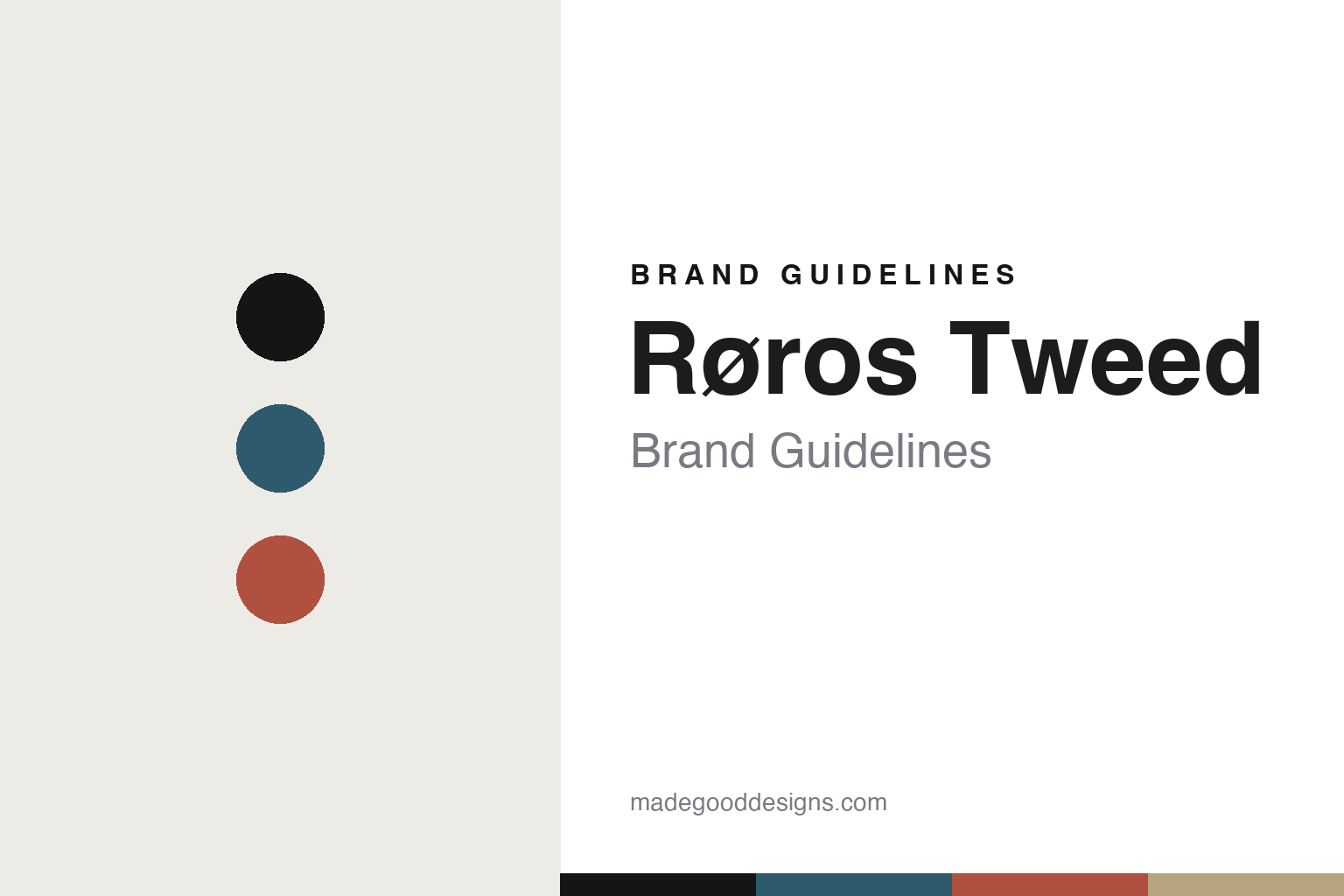
Røros Tweed Brand Guidelines
The wool blanket.
Aa
Two constants: a fjord-and-rust palette and a Nordic sans register. Abstract homage — not the Røros Tweed textiles, pattern or packaging.
The wool blanket
Røros Tweed weaves Norwegian wool in a heritage town.
Røros Tweed is a lesson in a place as identity. Tracing to 1940 in Røros, Norway — a UNESCO World Heritage copper-mining town — it weaves Norwegian wool into blankets and throws, made in Norway.
Its identity is Norwegian wool blankets. Røros Tweed makes wool blankets and throws “from raw wool to finished product,” on a Norwegian craft tradition matched to a modern Scandinavian aesthetic — bold patterns and colour. It develops those patterns with contemporary designers: verified collaborations include Anderssen & Voll (the Holiday Triptych, Fri, Isak) and Hallgeir Homstvedt (Knut). Warm wool, from a heritage town.
(Honest notes: the brand traces to 1940 in Røros, but sources don’t cleanly separate an original mill founding from any later relaunch, so we say “traces to 1940”; its founder and current ownership aren’t verified, so we don’t name them (an 18th-century mine director, Peder Hiort, appears only as historical context). We say “Norwegian wool” rather than “lambswool,” which isn’t explicitly confirmed, and we don’t claim eco-certifications, which we couldn’t verify. The name is heritage rather than a literal cloth type — Røros Tweed makes woollen blankets. There’s no official brand hex, and we reproduce no actual pattern — these tones are an unofficial interpretation. This is design commentary and does not promote any product.)
Colour
Røros Tweed lives in a fjord-and-rust palette. Click a swatch to copy the hex.
Røros Tweed’s identity is warm, natural and Norwegian — a fjord, an ink, a rust, a wool, and a chalk. The palette pairs a fjord with a rust — the register of bold Norwegian wool blankets. It signals craft and colour rather than novelty. The honest caveat: with no published brand hex, these tones are an original, unofficial interpretation, not first-party values.
The lesson is a fjord with a rust signals a Norwegian wool house. Røros Tweed’s world is a bold, woven blanket. For designers, it is a reminder that a place and a material — a heritage town, Norwegian wool — plus designer patterns can be a whole identity. Because a mid fjord can fail as small text, keep type dark and let the colour live in the accents, palette and band. The takeaways: root in a place; own a material (wool); commission the patterns; and treat any single hex as unofficial.
Typography
The register is a Nordic sans — warm, natural, Norwegian.
Røros Tweed’s identity carries a warm, natural, Norwegian spirit — a woven wool blanket. A clean Nordic sans captures the mood: it is calm and legible, the register of Scandinavian design. Set in a fjord-and-rust palette, the Nordic sans feels warm and natural — exactly the personality Røros Tweed carries. It is grounded rather than loud, mirroring woven wool. (Røros Tweed’s real textiles, patterns and wordmark are works we describe but do not reproduce, and the exact typeface is not ours to use.) Because it is not ours to use, the honest description is “a Nordic sans spirit,” shown here in a stand-in. The type behaves like the brand: warm, natural and Norwegian.
Aa
A Nordic sans spirit — warm and natural. (Specimen set in Hanken Grotesk, a clean Nordic sans STAND-IN; NOT the Røros Tweed packaging.)
A place as identity
Røros Tweed stands for Norwegian wool blankets.
Røros Tweed is a lesson in making a place the identity. A fjord-and-rust palette, a Nordic sans and a woven blanket make Norwegian wool the whole brand — warm, natural, Norwegian. The place is the differentiator. The differentiator is wool from a heritage town, patterned by designers.
For designers and brand-builders, Røros Tweed offers a clear takeaway: root a material in a place. The lessons: root in a place; own the material; commission the patterns; and be honest about the story. It is also a reminder to stay accurate: it traces to 1940 in Røros, its founder isn’t verified, and we say “Norwegian wool” not “lambswool” — the palette here is an unofficial interpretation. Røros Tweed made a place the brand — proof that wool and heritage can be the difference.
Explore & save
Keep Røros Tweed’s identity on hand — save it to a board in the Made Good inspiration library.
Røros Tweed identity set
Pin the fjord-and-rust palette and the Nordic-sans register to your own board.