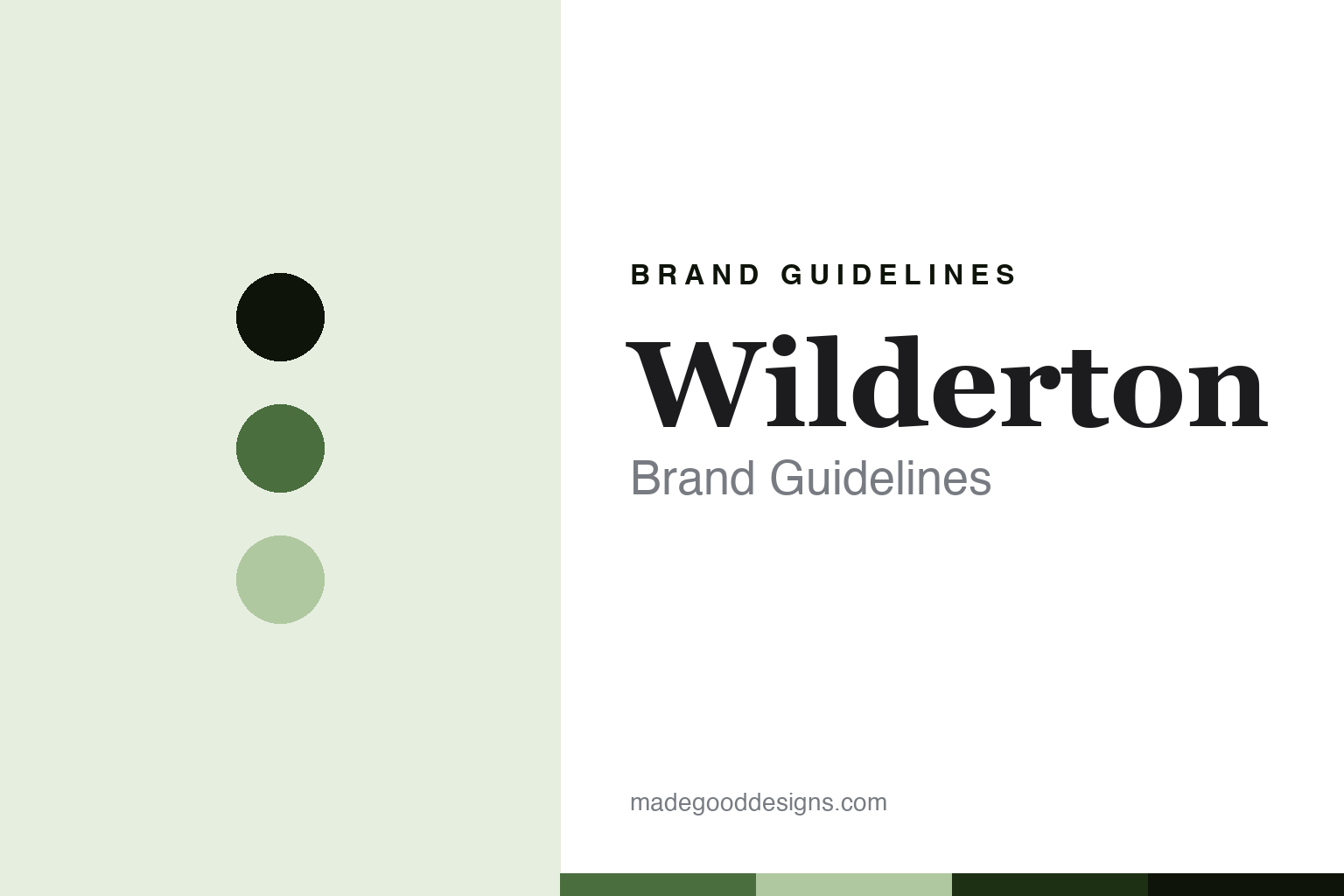
Wilderton Brand Guidelines
The Oregon distiller that closed its doors.
Aa
Two constants: an earthen-green palette and a botanical-serif register. Abstract homage — not a Wilderton product or mark.
The Oregon distiller that closed its doors
Wilderton is the Oregon botanical distiller that built the first US alcohol-free distillery — and then wound down.
Wilderton opens the second pour with the round’s most honest story — the Oregon botanical distiller, founded in 2019, that built what it billed as the first United States distillery dedicated entirely to alcohol-free spirits, and then, in early 2026, announced it was closing. Wilderton made non-alcoholic botanical distillates, and its answer to a round about the second pour is a genuine maker’s story that did not end happily: a real distillery, a standalone botanical spirit, and a shutdown. A brand, that closed.
Its identity is the Oregon distiller that closed its doors. Wilderton’s genuine distillation, its Oregon home and its winding-down are the story here. A brand, honest. The Oregon distiller that closed its doors.
(Honest notes, so the story stays precise, and this is an alcohol alternative, framed as commentary. Wilderton made non-alcoholic botanical distillates in three expressions: Lustre, a bright, herbal one with Seville orange, tarragon and lavender; Earthen, a smoky one with cardamom and pinewood; and Bittersweet, a non-alcoholic aperitivo. It was founded in 2019 in Hood River, Oregon by Brad Whiting and Seth O’Malley, veterans of Oregon craft spirits, and we name those two, not any other. On where it was made, a star theme of this round, it genuinely distilled at its own Hood River facility, and in 2023 opened on the waterfront what was billed as the country’s first distillery and tasting room dedicated entirely to non-alcoholic spirits. On status, the honest and central caveat: the founders announced in early 2026 that the company was winding down, with the tasting room closed in 2025, so we frame Wilderton as closing or closed, per those reports, and we do not imply it is currently on sale. It was independent and founder-led, and we found no B Corp certification, so we claim none. Its name and product names are IP we describe but do not reproduce; there is no official brand hex; these tones are an unofficial interpretation. This is design commentary.)
Colour
Wilderton lives in an earthen green. Click a swatch to copy the hex.
Wilderton’s identity is earthen, botanical and standalone — an earthen green, an ink, a sage, a deep moss, and a paper. The palette leans earthen green and sage: a muted, botanical register that nods to a distilled botanical and an Oregon landscape rather than a loud palette. It signals a standalone, genuinely distilled spirit. The honest caveat: with no published brand hex, these values are an original, unofficial interpretation, not first-party colours.
The lesson is an earthen green signals a botanical, made identity. Wilderton’s world is an earthen, distilled object. For designers, it is a reminder that an earthen green and a soft sage can carry a drink brand — the tone of a botanical distillate. Because these tones can fail as small text, keep type dark and let the colour live in the accents, palette and band. The takeaways: distil for real; stand alone; tell a status honestly; and treat any single hex as unofficial.
Typography
The register is a botanical serif — earthen, considered, made.
Wilderton’s identity carries an earthen, considered, made spirit — a botanical distiller, not a fashion. A botanical serif captures the mood: refined, earthy and confident, the register of a genuine maker. Set in an earthen-green palette, the botanical serif feels earthen and considered — exactly the personality Wilderton carried. It is a made thing rather than a logo, mirroring a botanical and a still. (Wilderton’s real bottle is a thing we describe but do not reproduce, and the exact typeface is not ours to use.) Because it is not ours to use, the honest description is “a botanical-serif spirit,” shown here in a stand-in. The type behaves like the brand: earthen, considered and made.
Aa
A botanical-serif spirit — earthen and considered. (Specimen set in Cormorant Garamond, a botanical-serif STAND-IN; NOT the Wilderton logo.)
The second pour
Wilderton stands for the Oregon distiller that closed its doors.
Wilderton opens the second pour with the round’s most honest story. An earthen-green palette, a botanical serif and a genuine distillery make one thing — the Oregon distiller that closed its doors — the whole identity: earthen, botanical and standalone. The genuine distillation is the substance, and the winding-down is the meaning. The point is a real Oregon distiller that built the first US alcohol-free distillery, then had to close.
Put to work, the identity is a maker’s story told straight, as design. A maker in this spirit would distil for real, stand alone, and tell a status honestly. A reader in this spirit would keep the facts right: Wilderton was founded in 2019 in Hood River, Oregon by Brad Whiting and Seth O’Malley; it made Lustre, Earthen and Bittersweet, standalone botanical distillates, not mimics; it distilled at its own Hood River facility and opened what it billed as the first US alcohol-free distillery and tasting room in 2023; and the founders announced in early 2026 that it was winding down. Wilderton opens the round’s genuine-distillers thread, and it is the poignant half of it: the indie maker who closes, set against Feragaia, the indie maker who opens and thrives. The honest editorial moves are to date it to 2019, to name the two founders, to say it genuinely distilled in Oregon, and to frame the shutdown per reports without implying it is buyable. The lesson Wilderton teaches is that genuine making can be a whole identity, and telling the status honestly keeps it credible.
For designers and brand-builders, Wilderton opens the second pour: distil for real — and tell a status honestly. The lessons: actually make the thing; build a standalone botanical rather than a mimic; take pride in a first, like the first US alcohol-free distillery; frame a closure plainly, per reports, when a brand winds down; and never reproduce a bottle. It is also a reminder to stay precise: Wilderton is the Oregon botanical distiller that built the first US alcohol-free distillery, then wound down — with the palette here an unofficial interpretation. Read that way, Wilderton is less a bottle than a maker: a genuine Oregon distiller, honestly closed. The lesson for a brand is that genuine making and an honest ending reinforce each other, and saying it wound down keeps the story earned. Wilderton made the-Oregon-distiller-that-closed-its-doors the identity — proof that an honest maker can open a round.
Explore & save
Keep Wilderton’s identity on hand — save it to a board in the Made Good inspiration library.
Wilderton identity set
Pin the earthen-green palette and the botanical-serif register to your own board.