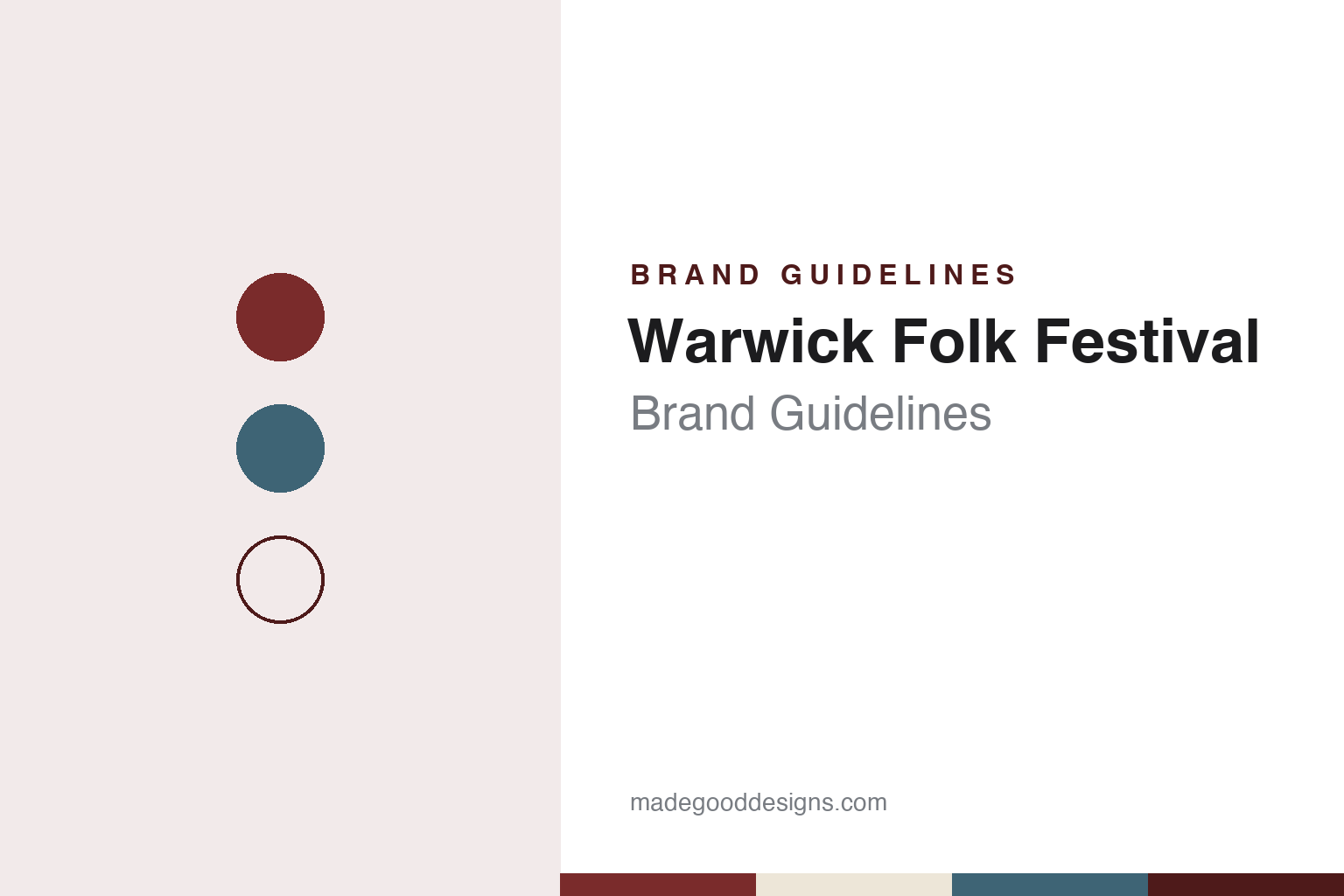
Warwick Folk Festival Brand Guidelines
A town festival of song and dance, now camped beside the castle.
Aa
Two constants: a castle red and Avon blue palette and a Friendly sans register. Abstract homage — not a Warwick Folk Festival mark; no logo, poster or programme is reproduced.
Ceilidhs before a festival
Planned from 1978, held from 1980.
Warwick Folk Festival is held each July in Warwick, Warwickshire, in the English Midlands. The festival’s own history, set out in an interview with its long-serving director Dick Dixon published on its website in 2025, says the idea took shape in January 1978, from a wish to celebrate folk music in the local area. The organisers looked at Coventry, Southam, Kenilworth and Warwick as possible homes before choosing Warwick.
The plan was at first to run a festival that same July. Instead, the history says, the team ran a season of ceilidhs — the Staff and Castles Ceilidhs, held in the town’s Court House — for about eighteen months, and staged the opening festival in July 1980. It began as a one-day event and became a two-day event in its second year; today it runs over four days, from Thursday to Sunday.
The early festival was spread around the town. The festival’s history says the campsite was at first on land that is now the car park for Myton Fields, and that the main music venue was the Lord Leycester Hotel on Jury Street. A ceilidh at Warwick School, in the school’s Guy Nelson Hall on Myton Road, began a long relationship with the school, and by the third year both the camping and the ceilidhs were held on the school site.
The edition numbers follow from that 1980 start. The Coventry Telegraph reported in March 2014 that the festival was celebrating its 35th year, at Warwick School from 24 to 27 July, with about 130 events including concerts, ceilidhs, workshops and a crafts and music fair, and with Dick Dixon as festival director. The festival describes itself as run by volunteers, with families who have attended for decades now among its management team.
Colour
From the school grounds to Castle Park.
For most of its history Warwick School was the festival’s centre. The Living Tradition, the folk magazine, described the school as the main festival location and campsite, with the main marquee for headline concerts, the school’s Bridge House Theatre for acoustic concerts, and the Guy Nelson Hall for ceilidhs and workshops, alongside a weekend craft fair. Events also ran in venues across the town, with dance tours, mumming plays, sessions and concerts.
The site then changed. In January 2020 the Coventry Telegraph reported that the festival was moving, in its 41st year, to Warwick Castle Park, the historic field beside Warwick Castle, having previously been staged at Warwick School. That year’s festival and the next were not held. In April 2022 the same paper reported that the festival would return from 21 to 24 July 2022 at Castle Park for its 42nd edition, noting that the new location put all the principal venues and the camping on one site, with views across the River Avon. It listed a main marquee, a ceilidh tent and a smaller outdoor stage, a craft fair and a food court, with a free shuttle bus taking visitors from the site into the town.
The festival has stayed at Castle Park since. The 45th edition was held there from 24 to 27 July 2025, according to the listings magazine What’s On, which also reported new glamping options that year, wheelchair access across the site, electric buggies and accessible camping.
The programme mixes headline concerts with participation. The 2014 Coventry Telegraph report named Richard Thompson among that year’s headliners, and in 2020 the paper named the Whitnash-born harmonica player Will Pound, who lives in Warwick, as the festival’s patron. Alongside the concerts the festival runs ceilidhs, sing-arounds, workshops, a festival choir and children’s events, and its stages carry names: visitor messages published on the festival’s website mention a Kingmaker stage.
Typography
Setting and calendar.
A folk festival rarely has a single building to stand for it. Its identity is carried instead by a place and a date: a seaside town that turns its gardens and promenade into stages for a week, an island whose villages and halls share the programme, a showground or estate field where marquees go up for a long weekend, a cultural village set in a rainforest, or a run of community halls in the cold months. The setting gives the festival its name, and the calendar fixes it in the memory, whether that is the week that takes in the first Monday in August or a bank holiday weekend at the end of summer.
The programme is the second layer. Concert marquees, standing big tops, dance houses, storytelling tents and children’s areas are usually given names of their own, and those names recur in programmes, on site maps and on stage boards year after year. Dance displays and processions take the festival out into the streets, so that teams of morris, sword, rapper or clog dancers become part of the look of the event as much as any printed material.
Print and lettering then travel from one edition to the next. A festival may commission a new poster each year while keeping the same wordmark, or keep a house style while changing its artwork; edition numbers, founding years and the name of the host town often sit beside the title on programmes, wristbands and listings. When a festival changes its name, moves to a new site or passes to a new organiser, these repeated elements are what carry its identity across the change.
The guides in this group look at folk festivals through those elements: where they are held, when they fall in the year, how their sites and stages are named, and how their names and printed matter have been handled over time. The colours and typefaces shown are our own interpretation, not official assets.
Aa
A friendly, open sans — a town festival with a castle beside it. (Specimen set in Work Sans, a sans STAND-IN; NOT the Warwick Folk Festival logo.)
Warwick
Morris sides in the market square.
Dance carries much of the festival into the town. Its own dance page says morris and traditional dance run from the Thursday opening to late on Sunday evening, with teams performing on the festival site and at programmed spots around the town centre, in a Saturday procession, during the evening ceilidhs and in workshops, including a youth morris workshop for ages 11 to 17. The styles it lists include Cotswold and Border morris, North West, rapper and clog, and molly dancing; in its current programme it welcomes 17 teams, among them local sides such as Earlsdon Morris and Chinewrde Morris. The Coventry Telegraph reported street dance across the town centre in 2014 and dance displays, music sessions and open-air concerts in the town in 2022.
That gives the festival two settings at once: a field with marquees beside the castle and the river, and the streets and squares of the old town. The shuttle bus between them, reported in 2022, is part of how visitors move through it, and one visitor message on the festival’s website describes a bus into town full of morris dancers.
The calendar is equally fixed. The festival sits in the second half of July — the 2014, 2022 and 2025 editions all fell between 21 and 27 July — at the start of the English school holidays, which its own “About us” page describes as the festival’s place in the year. A four-day pattern of Thursday to Sunday, with day visits alongside full weekends, shapes it as a family event, with a family camping area and children’s entertainment.
For a design guide, Warwick Folk Festival shows how an event can change its site after four decades and keep its identity through its calendar, its dance and its town. Compare Fairport’s Cropredy Convention, held in neighbouring Oxfordshire and also counting 1980 as its opening year, and Shrewsbury Folk Festival, another festival in the English Midlands. For this guide we use a castle red and an Avon blue with a sans, an unofficial interpretation; no product or logo is reproduced.
Explore & save
Keep Warwick Folk Festival’s identity on hand — save it to a board in the Made Good inspiration library.
Warwick Folk Festival identity set
Pin the castle red and Avon blue palette and the Friendly sans register to your own board.
Source & notes
Frequently Asked Questions
What font can I use to match the Warwick Folk Festival look?
This guide describes Warwick Folk Festival’s type as “A friendly, open sans — a town festival with a castle beside it”. Its type specimen is set in Work Sans from Google Fonts as a stand-in; Work Sans is not Warwick Folk Festival’s own lettering.
What colours are in the Warwick Folk Festival palette?
This guide’s Warwick Folk Festival palette is Castle red #7A2B2B, Deep brick #4E1A1A, Avon blue #3E6475, Sandstone #EDE6D8 and Paper #FAF8F3. The tones are the guide’s own unofficial interpretation, not official Warwick Folk Festival hex codes.
When was Warwick Folk Festival founded?
Warwick Folk Festival was founded in July 1980, in Warwick, Warwickshire.