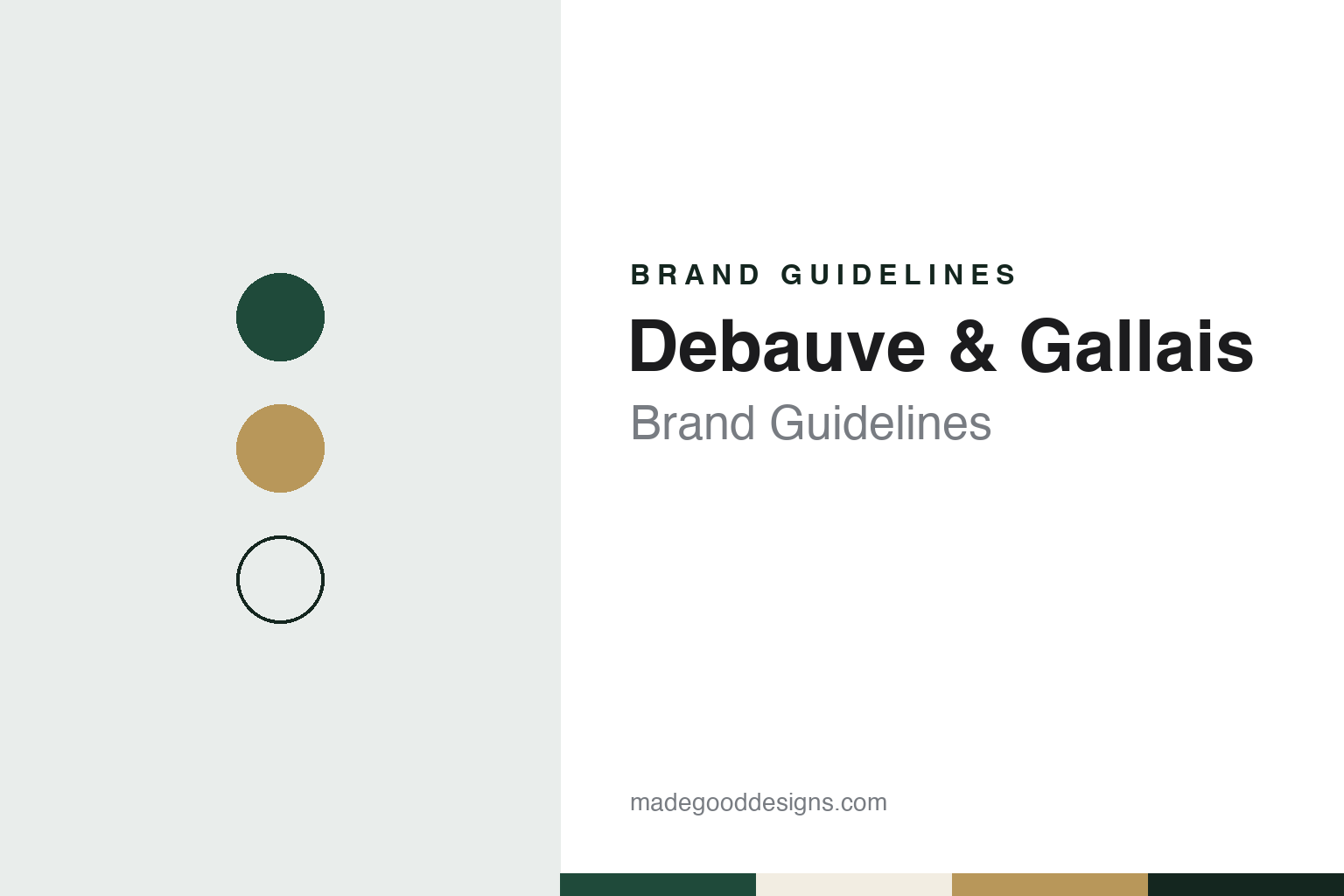
Debauve & Gallais Brand Guidelines
The 1800 Paris chocolate house of the pharmacist to Louis XVI.
Aa
Two constants: a shop-front green, vellum and gilt palette and a classical serif register. Abstract homage — not a Debauve & Gallais product or mark; no chocolate, box, chromo or logo is reproduced.
Pharmacist to the king
A pharmacist, a nephew and a shop on the Left Bank.
Debauve & Gallais dates itself to 1800, when Sulpice Debauve (1757–1836), a pharmacist who had served Louis XVI, opened a chocolate shop in the Faubourg Saint-Germain on Paris’s Left Bank. The company says he became the king’s pharmacist in 1779 and that his first shop was on the rue Saint-Dominique. In 1819 he moved to 30 rue des Saints-Pères, into a colonnaded shop designed by Percier and Fontaine, Napoleon’s architects. The shop has been listed as a historic monument since 1984, French Wikipedia says, citing the Mérimée heritage database; the company says the listing covers its façade and its semicircular counter, which it likens to an apothecary’s.
The house’s best-known story is told by the company itself. It says Debauve, knowing Marie-Antoinette’s taste for chocolate, mixed the medicine she took for headaches with cacao and almond milk to soften its bitterness, and that the queen named the resulting flat discs “pistoles.” Wikipedia repeats the story without a supporting source, so we give it as the house’s own account. The Pistoles de Marie-Antoinette remain its signature product, each engraved with a design the company says is inspired by the queen’s jewellery.
In 1823 Debauve took his nephew Jean-Baptiste Auguste Gallais (1787–1838), also a pharmacist, into partnership, and the firm took its present name. Gallais wrote a Monographie du cacao, which English Wikipedia dates to 1827 and the company to 1825. The gastronome Jean Anthelme Brillat-Savarin praised Debauve’s chocolate in his Physiologie du goût, crediting its quality to good materials and the master’s eye for detail.
Colour
Chocolatier to the kings of France.
The house built its name on royal custom. English and French Wikipedia say it supplied Napoleon and, after the Restoration, became the official chocolate supplier to Louis XVIII, Charles X and Louis-Philippe, receiving the title of purveyor to the court in 1819; the company dates its title of “fournisseur des rois de France” to 1825 and says it made a chocolate decorated with a fleur-de-lys for Charles X’s coronation. It also credits Debauve with the croquamandes, chocolate-coated almonds it dates to 1807 and attributes to an idea of Napoleon and the chef Antonin Carême — an attribution we give as the company’s.
Its early packaging drew comment. In 1832 the Revue de Paris described its chocolates as “wrapped in vellum paper, dressed in tin foil, placed in golden boxes,” and cast as shells, chestnuts and medals. The company says its teas were kept in black iron tins with gilt lettering. The motto on the shop front is Utile dulci, from Horace — the useful with the pleasant.
After the founders died, the business passed to a Mr Théry and, in 1857, to Nicolas-Eugène Hugon, who built a steam-powered factory in the 7th arrondissement — in 1857 according to English Wikipedia, 1858 according to French. Under his son Gustave the house won medals at the universal exhibitions of Paris in 1878, 1889 and 1900, and a gold medal at Antwerp in 1878 for its “chocolat éclair,” an instant drinking chocolate. The Hugon family ran the shop and factory into the 20th century, and Wikipedia says the style of the shop and its packaging was carefully preserved until the factory closed in 1966.
The house also issued chromos — chromolithographed advertising cards slipped into boxes, popular in the 19th century. The New York Times reported in January 2025 that it had revived them; the company says the five new cards, drawn by the illustrator Ilya Milstein, show famous customers of the house, and that a new box uses the green of the historic shop front.
Typography
Paris and Provence chocolate.
The seven brands in this group are all French chocolatiers: La Maison du Chocolat, Patrick Roger, Jean-Paul Hévin, Debauve & Gallais, Chapon, Richart and Puyricard. Most are names people meet first in a shop window rather than on a supermarket shelf, and their identities are built as much from boutiques, boxes and ribbons as from the chocolate inside.
France’s chocolate trade has a vocabulary of its own. A chocolatier is not always a chocolate maker: many houses buy couverture from specialist producers and put their craft into ganaches, pralinés and moulded or enrobed bonbons, while a growing number roast their own beans and make bars from bean to bar. Paris has long been the trade’s shop window, and the title Meilleur Ouvrier de France, awarded after a national competition, is one of the distinctions a chocolatier can carry on the door. Regional houses, often family-run, sell their own specialities alongside the chocolate.
Each guide separates what independent sources record from what the company says about itself — who founded it, who owns it now, where its chocolate is made and whether it makes that chocolate or shapes it — and marks plainly what rests only on the company’s own word.
Aa
A classical serif for a house of the First Empire. (Specimen set in Cormorant Garamond, a serif STAND-IN; NOT the Debauve & Gallais logo.)
Debauve & Gallais
An old name, a small Paris house.
The present company dates from 1989. Both Wikipedias say Paule Cuvelier took over the house that year and, with her son Bernard Poussin, expanded it abroad, listing outlets from New York to Tokyo, Seoul and Shanghai; those lists carry no supporting sources, and today’s website lists three shops, all in Paris. The New York Times named Domitille Jollois as president from 2022, and the French companies register lists her as president of Debauve & Gallais SAS, registered in 1989 under the activity code for chocolate making. The register does not show who holds the shares, and the sources we checked do not describe the change of leadership.
Where the chocolate is made today the company answers briefly. The house’s own factory closed in 1966; its website now says that all its fine chocolates are “made in France” by artisans it selects and works with closely to bring the house’s recipes to life. It does not name them. Its three shops are on the rue des Saints-Pères, on the rue Vivienne near the Palais-Royal and on the place des Vosges, where it shows part of its collection of historic chromos. It also sells teas and infusions, a line it says goes back to Debauve himself.
For a design guide, Debauve & Gallais shows how a listed shop, a royal story and old printed ephemera can serve as a brand’s whole identity. Compare Michel Cluizel, a French family chocolate house, and La Maison du Chocolat, another Paris house. For this guide we use shop-front green, vellum and gilt with a classical serif, an unofficial interpretation; no product or logo is reproduced.
Explore & save
Keep Debauve & Gallais’s identity on hand — save it to a board in the Made Good inspiration library.
Debauve & Gallais identity set
Pin the Debauve & Gallais shop-front green, vellum and gilt palette and the classical serif register to your own board.