Chocolat Jacques Brand Guidelines
The Belgian filled-bar maker from Verviers, now made in Bruges.
Aa
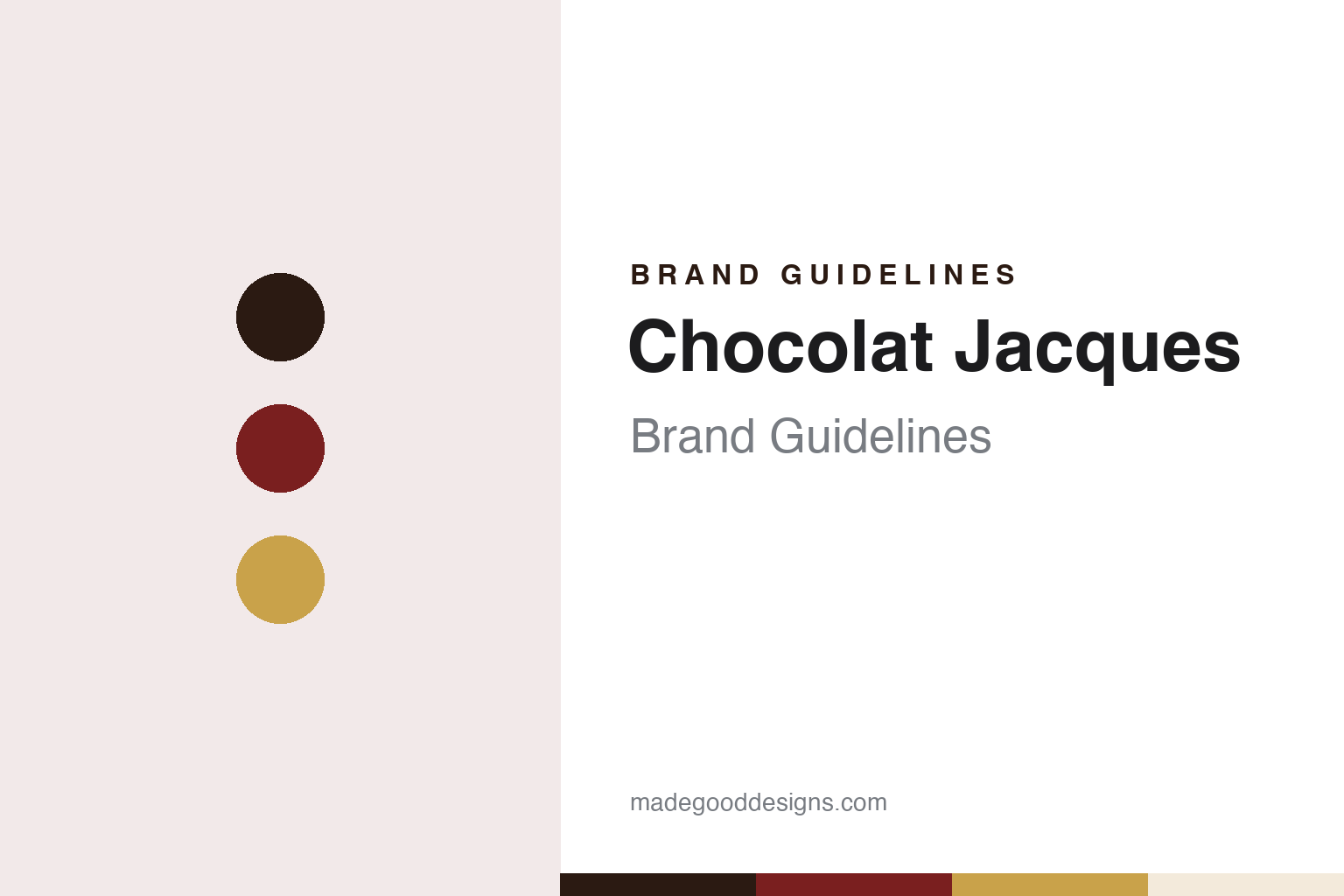
Two constants: a cocoa brown, knight red and album gold palette and a heritage serif register. Abstract homage — not a Chocolat Jacques product or mark; no wrapper, logo or picture card is reproduced.
Verviers, 1896
A gingerbread works that turned to chocolate.
Chocolat Jacques dates itself to 1896 and to Antoine Jacques (1858–1929), a trained confectioner in Verviers, the textile town east of Liège. English Wikipedia, citing the 2003 book Made in Belgium and the regional news site Ostbelgien Direkt, says Jacques had opened a gingerbread works in Verviers in 1890 with a partner, Jean Joseph Hardy; the pair added chocolate in 1894, and in 1896 Jacques parted from Hardy and carried on alone under the name “A. Jacques,” making gingerbread, sweets and chocolate. The brand’s owner today describes it as a “Belgian chocolatier since 1896.”
The early years were not smooth. English Wikipedia records a fire at the factory in 1899, prizes at regional exhibitions and at the St. Louis World’s Fair in 1904, a strike in 1906, a flood in 1908 and a halt to production during the First World War. In 1920 the business became a limited company, Chocolaterie A. Jacques; English Wikipedia names William Zurstrassen of Verviers as Jacques’s new partner, while the company’s own history speaks of a cooperation with a local chocolatier and says the new company had 43 employees from the start.
Within a few years production moved to Eupen, in Belgium’s German-speaking east, where there was room to make chocolate on a larger scale. The company dates the move to 1922 and English Wikipedia to 1923; either way, Eupen was the brand’s home for most of the next century. Antoine Jacques stepped back from the company in 1923 and 1924, English Wikipedia says, first as chairman of the board and then as a director.
Colour
Filled bars and picture cards.
The product the company is proudest of is the filled chocolate bar. Its website says Antoine Jacques invented the filled bar in 1936 and had the invention patented; the Belgian retail trade site RetailDetail wrote in 2018 that the company’s “claim to fame is the patent it filed in 1936 for the very first chocolate bar.” English Wikipedia tells a slightly longer story, dating a first filled bar, Noiseline, to 1931 and the patent application, and a six-piece “Superchocolat,” to 1936. We give these as the company’s and those sources’ accounts. Filled bars remain central to the range: the company says its banana-filled bar was eaten 1.7 million times in 2025.
For generations of Belgians the brand also meant picture cards. Between the 1930s and the 1980s, the company says, every bar came with an illustrated card about nature, history or distant countries, collected in Jacques albums — “Google avant la lettre,” as its Dutch-language site puts it. English Wikipedia lists album themes including trains and cars, the Belgian royal family, the Belgian Congo and Belgian geography, and mentions a 1966 Pinocchio album promoted through Tintin magazine.
English Wikipedia also describes an emblem from the late 1930s, the “Knight Jacques”: a knight with helmet, shield and spear on a rearing horse, which it says appeared on all the company’s own products. The company says it introduced a renewed logo and contemporary packaging in 2020, a fresh visual identity on social media in 2023, and in 2026 a new website and web shop “in line with the renewed brand identity.”
Today’s range, according to the brand’s website and English Wikipedia, includes Matinettes, thin chocolate slices for bread — the company says 16.2 million were eaten in 2025 — as well as chocolate sprinkles, filled bars, tablets and chocolate for baking.
Typography
Design and documentation.
The seven brands in this group all make chocolate, and they come from three countries: Mary, Dumon and Chocolat Jacques from Belgium, Manner, Mirabell and Hofbauer from Austria, and Sarotti from Germany. Chocolate brands reach shoppers in different ways, from a chocolatier’s own shop counter to a bar or a box on a supermarket shelf.
An old chocolate brand can carry two histories at once. One is the story of a founder, a workshop and a city, which a brand may keep telling on its packs and its website long after the founding family has gone. The other is the story of ownership: who bought the business, who bought it after that, and which group’s factory the chocolate comes from now. The two need not line up: a name tied to one town can be made somewhere else, or by a company based in another country.
Each guide separates what independent sources record from what the company says about itself — who founded it, who owns it now, where its cocoa comes from and where its chocolate is made — and marks plainly what rests only on the company’s own word.
Aa
A heritage serif — for a brand once marked by a mounted knight. (Specimen set in DM Serif Display, a serif STAND-IN; NOT the Chocolat Jacques logo.)
Chocolat Jacques
From Stollwerck to Baronie.
Ownership followed the consolidation of Europe’s chocolate industry. English Wikipedia says Jacques joined the distribution company Continental Sweets Belgium in 1976 and the Cologne chocolate group Stollwerck in 1982, keeping its name and logo; the company calls the buyer Stollwerck-Sprengel and says a modern production site followed in 1994. In 2002 the Swiss-based cocoa processor Barry Callebaut bought Stollwerck, the Neue Zürcher Zeitung reported, and in 2011 it sold Stollwerck, Jacques included, to the Baronie group of Veurne, in West Flanders, Reuters reported that July.
The Eupen factory did not survive the change. RetailDetail reported in October 2018 that Baronie said the plant had made losses since 2011, when it stopped making its own chocolate and began processing chocolate supplied from elsewhere into bars and pralines; around 70 jobs were at stake. VRT News reported the closure decision in November 2018, and the Belgian news agency Belga reported that the factory would close for good on 17 May 2019. The company says bar production moved that year to “the new ultramodern factory in Bruges,” and the brand’s contact address is in Bruges, where Baronie’s Belgian company is registered.
Baronie lists Chocolat Jacques among its own brands alongside Sarotti, Alpia, Alprose and Duc d’O, and says it has ten locations in five European countries. The company says Jacques uses only cocoa butter, with no other vegetable fats, carries the “Belgian chocolate” label, has signed the code of the Belgian confectionery federation Choprabisco, and uses only Rainforest Alliance certified cocoa; we give these as its claims.
For a design guide, Chocolat Jacques shows how a regional brand can be carried by small rituals — a card in every bar, a slice of chocolate on breakfast bread — long after its factory has closed. Compare Stollwerck, its parent company since 1982, and Sarotti, a Berlin brand in the same group. For this guide we use cocoa brown, a deep knight red and an album gold with a serif, an unofficial interpretation; no product or logo is reproduced.
Explore & save
Keep Chocolat Jacques’s identity on hand — save it to a board in the Made Good inspiration library.
Chocolat Jacques identity set
Pin the Chocolat Jacques cocoa brown, knight red and album gold palette and the heritage serif register to your own board.