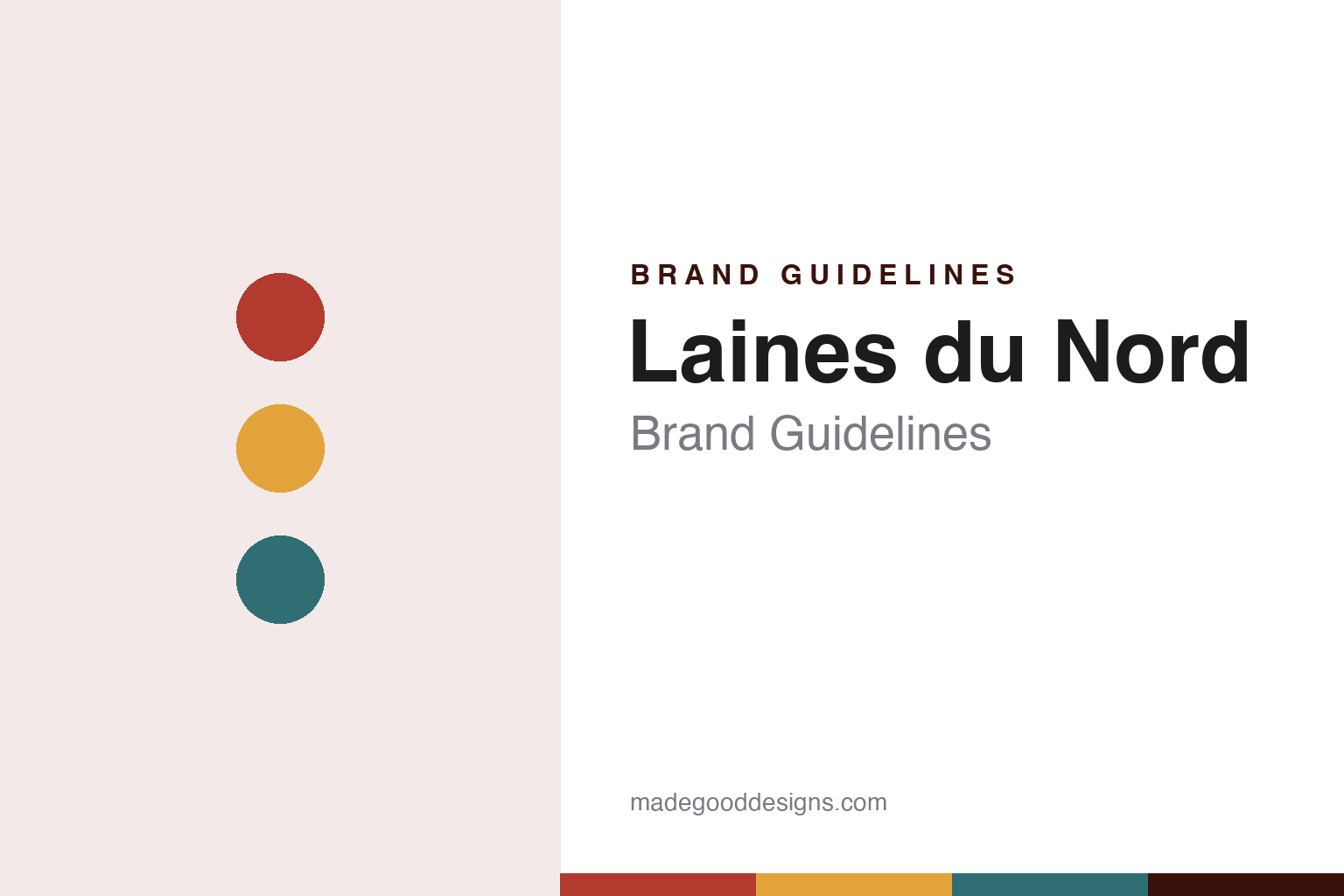
Laines du Nord Brand Guidelines
The Piedmont yarn maker with a French name.
Aa
Two constants: a Laines du Nord red, saffron and teal palette and a geometric sans register. Abstract homage — not a Laines du Nord product or mark; no ball band, logo or label is reproduced.
A French name in Piedmont
An Italian yarn house that chose a French name.
Laines du Nord sounds French — the phrase means “wools of the North” — but the brand is Italian. Its website gives its address as Avigliana, a town in the Susa Valley in the province of Turin, in Piedmont, where it also keeps a showroom that knitters and shops can visit by appointment. The VAT holder behind the website’s footer is Laines du Nord S.r.l., with its registered office in Turin, according to the European Commission’s VIES VAT register, which we queried in October 2026.
The company does not give a founding year on the pages we were able to read, and we found no independent account of its origins, so we do not give one. What it does give is a running count. In 2015 the title of its homepage read “Produciamo da oltre 30 anni filati di massima qualità” — “we have been producing top-quality yarns for more than 30 years.” By 2020 its English “Company” page said: “For over 40 years we have been producing in Italy unique and high quality yarns for knitting.” Both are the company’s own statements, and they point to a business that was making yarn by the early 1980s, but they are not a documented date.
The brand has been online for some time. The Internet Archive first captured lainesdunord.com in May 2010; by 2015 the site showed seasonal collections for 2013 and for 2014–2015 and a yarn catalogue, and it later moved to an Italian domain, lainesdunord.it, to which the older address now redirects. Its websites have been built by Claim Creative, the agency named in the site credits.
Colour
Colour, natural fibres and a Made in Italy claim.
Laines du Nord describes itself first as a colour house. Its 2020 company page says the work “begins with a careful selection of raw materials, which after a long and adventurous journey arrive here,” and that “Italian artisan tradition, technological innovation and continuous creative research combine together to develop always new shades and geometric patterns.” It calls itself “specialists in the use of color for the production of balls of yarn.”
The same page sets out what it means by Made in Italy: “use of 100% natural and fine raw materials,” design of the yarns, “100% production on the Italian territory,” “shearings and treatments respectful of animals’ well-being,” and research and development. It says its yarns are “produced in our textile company, 100% Made in Italy.” We give these as the company’s claims. The phrase about a “long and adventurous journey” implies that at least some fibre is imported before it is processed in Italy, which is normal for the trade, but the company does not say where its wool, cotton or other fibres are grown, nor name the mills involved, and we could not establish whether it spins its yarns itself or has them spun to its specification.
The range is seasonal, with autumn-and-winter and spring-and-summer collections and free and paid patterns. Names that appear on its blog include Andina and Andina Color, Agave, Summer Sock and Vivaldi, and in March 2026 it presented a new collection called Astra. The blog, now called “The Knitting Room,” mixes product news with features on trends, techniques and holidays, and the site has a store locator for its stockists. The company also says it holds certifications for its products, which we did not check one by one.
Typography
Design and documentation.
The seven brands in this group all sell yarn for hand knitting and crochet, and they are linked to six countries: Paintbox Yarns and Erika Knight from the United Kingdom, Juniper Moon Farm from the United States, Lamana from Germany, Laines du Nord from Italy, De Rerum Natura from France, and ITO, a label run from Germany whose yarns, it says, come from Japan. What they share is less a place than a question: who actually makes the yarn that carries the name on the label?
Some yarn brands are, in effect, designer or retailer labels. The company chooses the fibres, sets the colour card, writes the patterns and builds the brand, but the spinning and dyeing are done by mills elsewhere, sometimes in another country, and the name on the ball tells you who designed it rather than who made it. Others are fibre-led, built around a particular wool, a flock or a mill, where the story of the yarn starts with the raw material and the place it was grown or spun.
Many brands sit somewhere between the two, and their own descriptions do not always make the line clear. Each guide therefore separates what independent sources record from what the company says about itself — who founded it, who owns it now and where its yarn is made — and marks plainly what rests only on the company’s own word.
Aa
A geometric sans for a colour-led yarn house. (Specimen set in Outfit, a sans STAND-IN; NOT the Laines du Nord logo.)
Laines du Nord
A small company that lets its colours do the talking.
Laines du Nord is a small, privately held company, and the public record on it is thin. Its own website is the main source for what it makes and how, and much of that site sits behind a security check that blocks automated reading; we relied on copies kept by the Internet Archive between 2015 and 2024. We found no reports of an acquisition or a change of owner, and no information on who founded it, in the sources we checked. Its footer has carried the same VAT number since at least 2019, linked to Laines du Nord S.r.l. in Turin.
Its location places it in a region with a long textile history. Piedmont is home to the Biella wool district, north-east of Turin, where yarn houses such as Filatura di Crosa and Lana Gatto are based. Avigliana lies in the other direction, in the Susa Valley west of the city, and the company presents itself less as a heritage mill than as a design-and-colour business, with a showroom “inspired to the world and the art of Knitting” and seasonal collections photographed and styled like fashion.
The French name is part of that positioning. The company does not explain it on the pages we read, so we do not guess at its origin; what can be said is that a French-sounding name on an Italian-made product is the brand’s chosen identity, and that its own copy leans hard on the Made in Italy label rather than on any French link.
For a design guide, Laines du Nord shows how a small yarn house can build its identity around colour and a country-of-origin claim. Compare Adriafil, another Italian yarn brand with its own mill story, and Filatura di Crosa in Biella. For this guide we use a brick red, saffron and teal with a sans, an unofficial interpretation; no product or logo is reproduced.
Explore & save
Keep Laines du Nord’s identity on hand — save it to a board in the Made Good inspiration library.
Laines du Nord identity set
Pin the Laines du Nord red, saffron and teal palette and the geometric sans register to your own board.