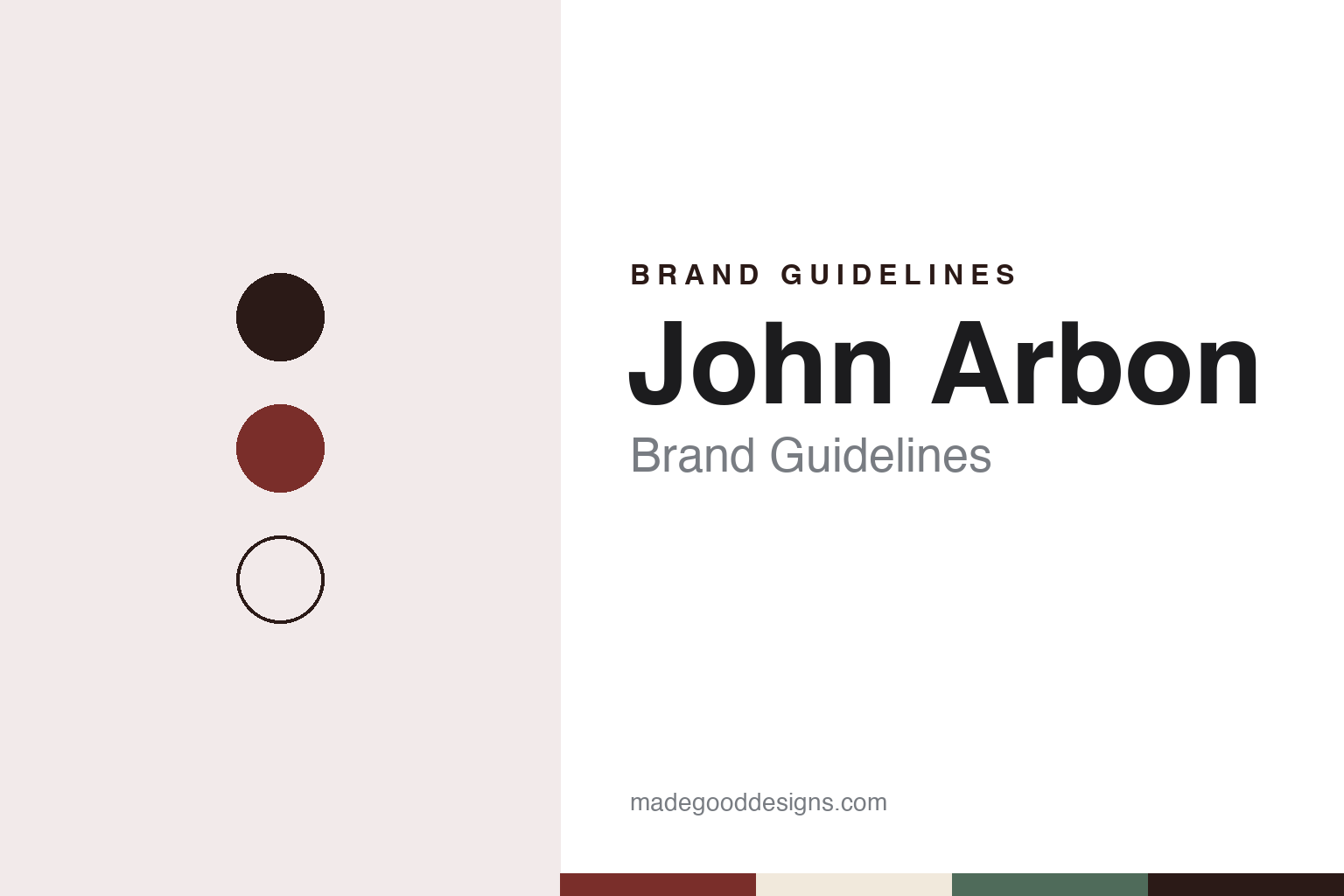
John Arbon Brand Guidelines
The North Devon worsted mill that spins local wool on vintage machines.
Aa
Two constants: a Devon red, undyed cream and Exmoor green palette and a slab serif register. Abstract homage — not a John Arbon Textiles product or mark; no label, logo or pattern is reproduced.
Socks, alpaca and a mill
A sock maker who built his own spinning mill.
John Arbon Textiles takes its name from John Arbon, and began as much with socks as with knitting yarn. The company says its mill was founded in 2001, on a simple idea: a return to old-style textile manufacture, buying raw fibre locally wherever possible and turning it into tops and yarn in Britain rather than chasing the cheapest labour abroad.
An archived version of its website from January 2013 shows the early business clearly. It described John Arbon Textiles and Fibre Harvest as “British makers of unisex socks, yarns and fibres,” and said John Arbon had spent twelve years developing a range of British-made alpaca, merino and British wool socks, from walking socks to bed socks. The yarn for those socks, it said, was made at the company’s own worsted spinning mill, on vintage machinery, alongside hand-knitting yarns and custom yarns for other firms — among them a garden twine made from the wool of White Face Dartmoor sheep. The same page already listed a Knit by Numbers range and an Exmoor Blueface sock.
Over the following decade the emphasis moved to hand knitters and hand spinners. The company now describes itself as an independent micro business making yarns and fibre tops in North Devon, and its mill shop is in South Molton, on the southern edge of Exmoor. It has held an annual Mill Open Weekend there since 2016, it says, and publishes The Annual, a knitting book of patterns and articles now in its sixth issue.
Colour
Gill boxes, spinners and skein winders.
The John Arbon brand is built on its machinery and its method. The company calls its South Molton mill one of only a handful of small-scale worsted spinning mills still operating in the UK, a claim we have not tested. Worsted spinning works from combed fibre, so that the fibres lie parallel and the yarn is smooth and strong.
The company is open about which steps it does itself. Scouring, carding, combing and dyeing happen off site in the UK — its fibre goes “up to Yorkshire” for those stages, it says — and the dyed fibre then returns to the mill. There it passes through gill boxes at least three times to straighten and align it, is spun on machines including a 1980s French ring spinner, rests for a week, and is then plied and skeined on vintage cast-iron skein winders made in Bradford. Most machines were rescued from mills as they closed, the company says, and each has a name; its yarns, apart from the Exmoor Sock, are not superwash-treated.
Its sourcing is local by design. The company says South West wool comes into the British Wool depot near its mill, and that it was the first yarn company to use British Wool’s new traceability scheme, with wool bought at auction since September 2022 traceable to the farm. It also buys fibre from the Falklands and elsewhere. Its own ranges include Exmoor Sock, Devonia, Knit by Numbers and Harvest Hues, sold as yarn and as fibre tops.
The mill also works for others. It says it custom-spins bases for independent brands and dyers in England, Germany, Switzerland, Austria and the Netherlands, among them the designer Marie Wallin’s British Breeds yarn and Daughter of a Shepherd’s Hebridean yarns.
Typography
British wool and the mills that spin it.
The seven brands in this group all sell British yarn for hand knitting and crochet: West Yorkshire Spinners, John Arbon, Baa Ram Ewe, Blacker Yarns, Laxtons, Uist Wool and Fyberspates. They share a country, but not a way of making yarn, and the difference between them says a good deal about what is left of Britain’s wool industry.
Britain once spun yarn on an industrial scale, and the mills that remain are a small fraction of what there was. Some brands still own the machinery that turns fleece into yarn. Others design yarns and colours and pay a mill — at home or abroad — to spin them, which is how much of the modern yarn trade works. Between the two sit firms that do part of the work themselves, such as dyeing or blending, and buy in the rest. A brand’s label rarely makes clear which kind of company it is.
Each guide separates what independent sources record from what the company says about itself — who founded it, who owns it now and where its yarn is spun and dyed — and marks plainly what rests only on the company’s own word.
Aa
A sturdy slab serif for a working mill. (Specimen set in Bitter, a slab-serif STAND-IN; NOT the John Arbon Textiles logo.)
John Arbon
A founder’s name, run by the mill’s directors.
The name has outlived its founder’s management. The company says Helena Timms, who joined in 2017 to run the machines, took over running the business from John and Juliet in 2022, and now leads it as mill director alongside Sonja Bargielowski, who is responsible for marketing.
Companies House records the handover. A company called John Arbon Ltd, registered in Bideford, Devon, was incorporated in January 2022 with the spinning of textile fibres among its activities; Helena Timms and Sonja Bargielowski are each listed as holding between a quarter and a half of its shares. The earlier company, John Arbon Textiles Limited, incorporated in 2016 with John Arbon and Juliet Sensicle each holding between a quarter and a half, changed its name in July 2022 to John Arbon & Lyn Valley Textiles Limited; both companies were listed as active in October 2026. The register does not say what passed between them, so we describe only what it shows. Lyn Valley points to Lynton, on the north Devon coast, where the company says it once had a shop.
John Arbon remains, in short, a small independent mill owned by the people who run it rather than a brand inside a group. Its identity — named machines, mill tours, a printed annual and wool traced to Devon farms — is that of a workshop that invites customers in.
For a design guide, John Arbon shows how a founder’s name and a working mill can carry a brand after a change of hands. Compare Blacker Yarns, a West Country mill, and West Yorkshire Spinners, a larger British spinner. For this guide we use Devon red, undyed cream and Exmoor green with a slab serif, an unofficial interpretation; no product or logo is reproduced.
Explore & save
Keep John Arbon’s identity on hand — save it to a board in the Made Good inspiration library.
John Arbon identity set
Pin the John Arbon Devon red, undyed cream and Exmoor green palette and the slab serif register to your own board.