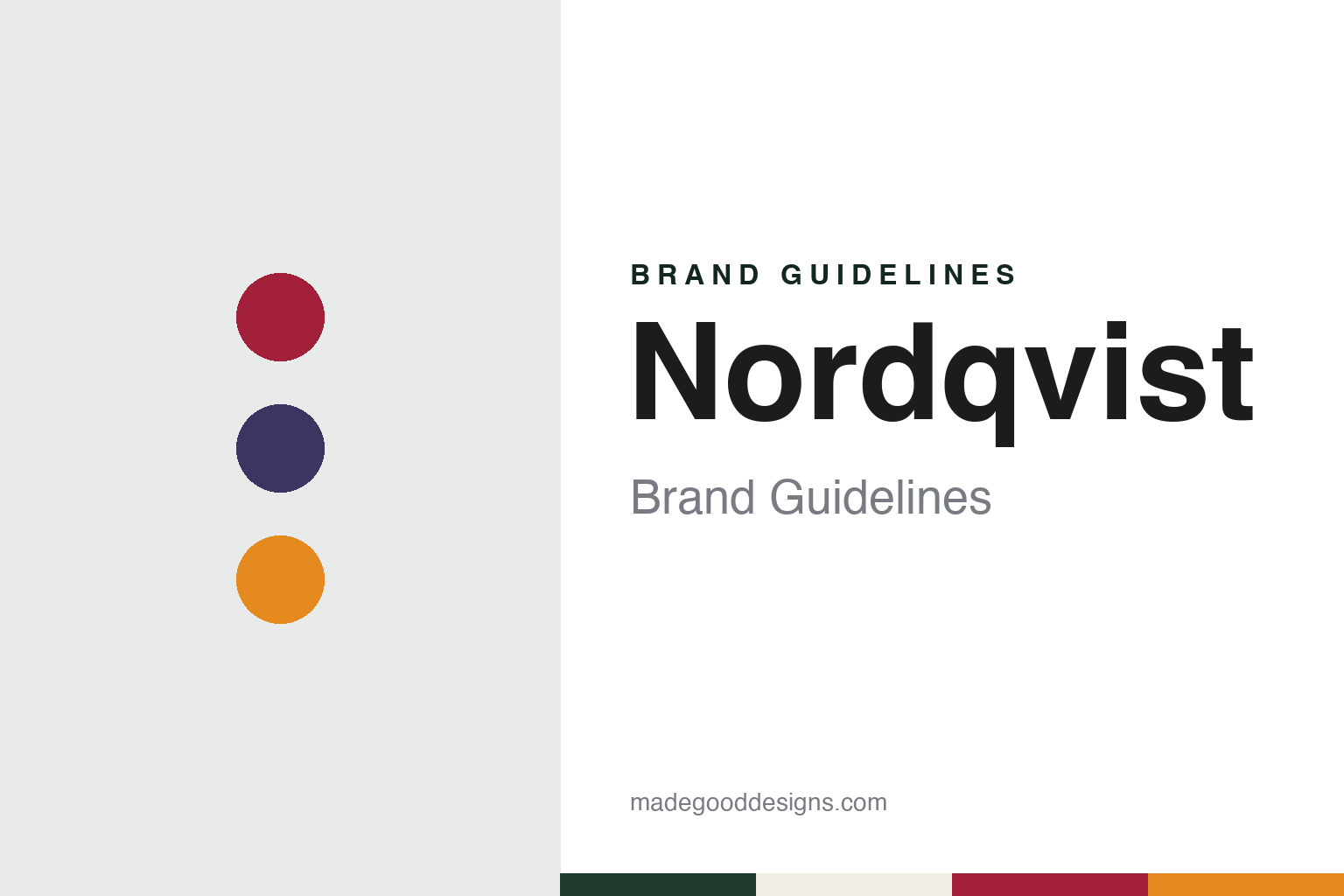
Nordqvist Brand Guidelines
The Helsinki tea shop that became a Finnish tea house.
Aa
Two constants: a Nordqvist spruce, berry and birch palette and a rounded geometric sans register. Abstract homage — not a Nordqvist product or mark; no pack, logo or label is reproduced.
A tea shop in Helsinki
Flavoured tea sold loose, when that was new in Finland.
Nordqvist began as a shop. The company dates itself to 1979, when a tea retailer opened in Helsinki selling flavoured and unflavoured teas by weight from its own imports. The company’s own history credits Sirpa Nordqvist as founder and calls a shop specialising in flavoured tea and loose sale “a new concept in Finland” at the time. Finnish Wikipedia and a 2021 profile published by the entrepreneurs’ association Uudenmaan Yrittäjät name both Sirpa and Hannu Nordqvist; the 2021 profile describes them as keen tea drinkers who sold their tea in their own delicatessen shops in the Hietalahti market hall and at Kaivopiha in central Helsinki. In March 2024 the newspaper Aamuposti marked 45 years since Sirpa Nordqvist founded the tea house.
The shops led to wholesale. According to the company, retailers around Finland began asking to buy its tea, and that is how its import and wholesale business started. In the 2021 profile, the current chief executive Riku Nordqvist, Sirpa and Hannu’s son, says that demand “made Nordqvist a wholesaler”: the family bought its first packing machine and offered its most popular teas to grocery chains. He describes the product line moving from loose leaf to tea bags, and then from tea bags to pyramid bags.
The business has remained in the family. Finnish Wikipedia lists Riku Nordqvist as chief executive and Sirpa Nordqvist as chair of Nordqvist Oy, and calls it a family company specialising in importing, making and packing tea. Aamuposti reported in 2024 that Sirpa Nordqvist had handed the running of the company to her children. We found no record of an outside owner or an acquisition in the sources we checked.
Colour
The Emperor’s Bride and other flavoured blends.
Nordqvist’s reputation rests on flavoured blends with Finnish names. The best known is Keisarin Morsian, “the Emperor’s Bride.” Finnish Wikipedia, citing Pirkko Arstila’s Teen ystävän kirja (2011), says the blend was developed at Nordqvist in 1985 around a story of an emperor who sent a tea he had flavoured himself to the woman he hoped to marry. It describes the tea as Assam and Ceylon black tea flavoured with elder and quince, with pieces of orange peel and pineapple and flower petals, and notes a caffeine-free rooibos version. The company has long called it Finland’s most popular flavoured tea, which we give as its claim.
The company names Teetaivas (“tea heaven”) and Tiikerin Päiväuni (“the tiger’s daydream”) alongside it as classics. Its shop also sells a range of Moomin teas built around the characters of Tove Jansson’s Moominvalley, which it says have delighted tea drinkers “for years”, and an organic, Fairtrade range called Luonnontee.
On sourcing, Nordqvist says its tea comes from selected regions “including Japan, Kenya and Sri Lanka,” and that what makes its tea Finnish is the work done in Finland: blending, flavouring and packing, Finnish berries such as bilberry, lingonberry and sea buckthorn, which it says it freeze-dries, and packs designed in Finland. It says all its tea packs carry a Rainforest Alliance, organic or Fairtrade certification, and that in autumn 2022, 95 per cent of the tea and rooibos it used was Rainforest Alliance or Fairtrade certified; it also lists FSSC 22000 food-safety certification.
In the 2021 profile Riku Nordqvist said the company was among the top three tea sellers in Finland by sales, together with Unilever and Twinings, and named Japan, Russia, the United States, Britain, Germany and Sweden as its main export markets at the time.
Typography
Tea from far away, packed close to home.
The seven brands in this group all sell tea, and they come from five countries: Taj Mahal Tea and Society Tea from India, Akbar and Mlesna from Sri Lanka, Betjeman & Barton from France, Hälssen & Lyon from Germany, and Nordqvist from Finland. Two of those countries grow tea on a large scale; the other three do not, so the tea sold under a brand from there was grown somewhere else.
That split makes the usual questions sharper. For a brand from a growing country, the label may promise a garden, a region or a national style of tea; for one from a country that grows none, the promise rests on the blend, the flavouring, the shop and the box. In both cases the name on the front and the place where the tea was grown, blended and packed can be several countries apart.
Each guide separates what independent sources record from what the company says about itself — who started it, who owns it now, where its leaf is bought and where its tea is actually blended and packed — and marks plainly what rests only on the company’s own word.
Aa
A rounded geometric sans — the register of the company’s web shop. (Specimen set in Poppins, a sans STAND-IN; NOT the Nordqvist logo.)
Nordqvist
A factory at Ilvesvuori.
Nordqvist’s tea is flavoured and packed in Finland. In 2006 the parish newspaper Vantaan Lauri described the company, then with around ten employees, packing tea in the Koivuvaara industrial area of Vantaa. In 2018 the local press reported that it had moved all of its operations from Petikko in Vantaa to a new production plant at Ilvesvuori in Nurmijärvi, north of Helsinki, where more than a million kilos of tea a year were flavoured and packed. The company describes the factory as 3,000 square metres and says its electricity comes entirely from fossil-free renewable sources, with 95 per cent of its heat from renewables and solar panels on site; we give those as its claims.
The figures in the press are modest. The 2021 profile gave revenue of about €6.5 million in 2020 and just over 30 employees, half in production and logistics; Finnish Wikipedia, citing a business directory, gives revenue of about €7.4 million in 2024 and 28 staff. In 2021 the company said it aimed for exports to reach half of its revenue within a decade.
The company’s look is its own work. It says the Luonnontee packs, decorated with plants of the Finnish forest and meadow from bilberries to birch leaves, were designed in-house, and that its packaging materials come from a Finnish manufacturer. Its web shop uses the Poppins and Bebas Neue typefaces; we found no published account of its logo or brand colours.
For a design guide, Nordqvist shows how a tea brand can build a national identity from names, stories and flavourings rather than from where the leaf is grown. Compare Twinings, the competitor Riku Nordqvist named in 2021, and Ronnefeldt, another family tea house. For this guide we use spruce green, lingonberry, bilberry and sea buckthorn with a sans, an unofficial interpretation; no product or logo is reproduced.
Explore & save
Keep Nordqvist’s identity on hand — save it to a board in the Made Good inspiration library.
Nordqvist identity set
Pin the Nordqvist spruce, berry and birch palette and the rounded geometric sans register to your own board.